

/
RSS Feed
Speaker 1  00:00
Hi guys。

Speaker 2  00:01
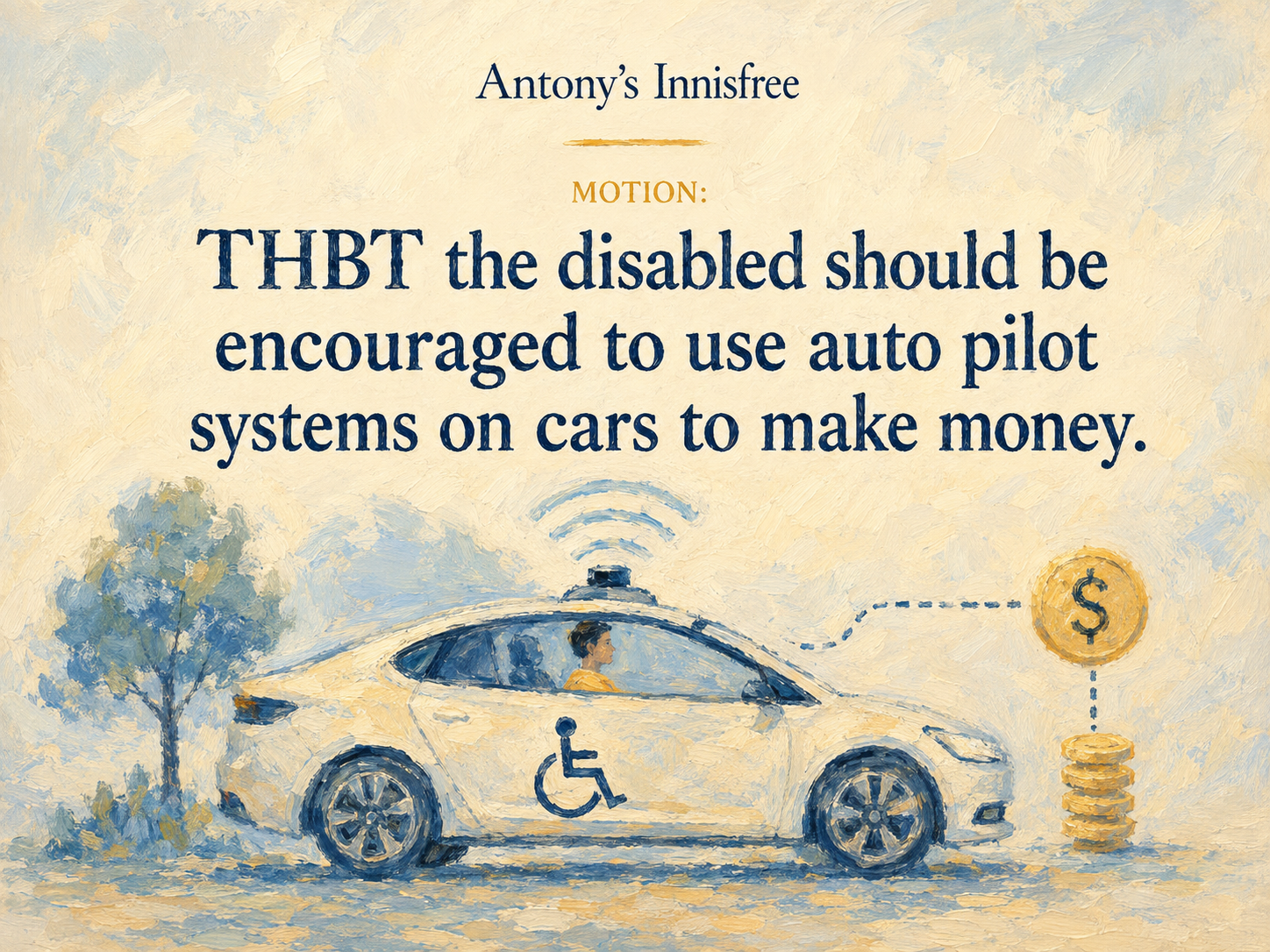
Welcome to the second motion in the motion analysis series on both BP debate union and Anthony's industry. In this episode we're gonna talk about um, whether to support or to Encourage people with disability to use autopilot systems on cars to make money.

Speaker 1  00:26
Well。

Speaker 2  00:26
Um the thing is that a few days ago I saw a piece of news um from last year of a man who is disabled in texas using Tesla's full self driving system to drive for uber. And um he says that he uses this feature to support his family.

Speaker 2  00:45
 So obviously we can see that it's quite important for him. And, ah the the passenger who posted this post on X also says that it is a very, um。

Speaker 2  00:58
Heartwarming to see that, uh, this person uh. Given him such a right experience.

Speaker 2  01:08
But um something just came to my concern that if that guy is disabled, but at the time, at the same time driving uber with passengers who is going to be responsible when certain accidents happen on the road,

Speaker 2  01:22
 um will the system be responsible? Will Tesla be responsible or would the driver be responsible? That's gonna be an issue, right? But fortunately we don't have any issues yet.

Speaker 2  01:34
 And there are people arguing that um autopilot systems actually provides more security, more safety, um because there areAlgorithms and they make less mistakes than humans. And there are also data supportingIT.

Speaker 2  01:49
But ah do people really buy it? We're not sure. Right. A lot of people still believe that um humans should still supervise these sort of autopilot features. As we can see from most um autopilot systems, ah provided by ah whoever。

Speaker 1  02:08
I don't know Tesla。

Speaker 2  02:09
By Xiaomi。

Speaker 1  02:10
By anybody.

Speaker 2  02:11
Um in their terms of services, they require the customer, whoever uses their autopilot feature to supervise their systems when they're working. So even though you are on the driver seat and you turn your autopilot autopilot on,

Speaker 2  02:24
 you still have to pay attention to the road. You need to know what's going on and be ready to take control over the system to protect yourself from any possible harm or any possible injuries or risks on the road because um they cannot guarantee that the system would one hundredPercent not make any mistakes even though they can try to build the system to beBetter.

Speaker 2  02:46
There are still a lot of conditions on the road that are um less likely to be predicted or foreseen. So it's still very important for human drivers to constantly pay attention to the road and um you know intervene the system when necessary to protect them from any potential harms.

Speaker 2  03:07
 Now coming to the motion that we're discussing today, this house believes that disabled should be Encouraged to use autopilot systems to make money. Well,

Speaker 2  03:19
 we do understand that um it's gonna be quite important for a disabledPerson to have a steady income. Um and driving for uber can be one of the one of the ways we have toAdmit.

Speaker 2  03:33
But um there are basically two voices talking about this issue. One is that they should um use this feature as they are the customer and they have bought it,

Speaker 2  03:43
 then why don't leverage it since that this kind this kind of systems are kind of safe and it's very um not likely that any accident would happen on the road.

Speaker 2  03:54
 A lot of people are willing to take the risk and um you know drive for uber and earn some money. And the experience that we have seen is quite successful, that um he did earn a lot of money andNo accidents actuallyHappen.

Speaker 2  04:09
Well, some other people would think, ah for example, me would think that it's gonna be。

Speaker 1  04:15
Uh。

Speaker 2  04:16
Potentially dangerous because when you are um having a normal driver, uh I mean an ordinary driver, they have the ability to intervene to intervene the system when the system goes wrong.

Speaker 2  04:29
 And that's kind of important because you can't make sure that the system one hundred percent would be safe and would be ah be able to cope with any conditions on the road.

Speaker 2  04:41
 So it's kind of important to have that safeguard of a human driver. Well when it comes to um disabled people, people with with mild disability may beAbleTo。

Speaker 1  04:53
Uh you know。

Speaker 2  04:54
Control the car, but people with severe disability might not be able to take quick reactions on these incidents. So it's so it's still gonna be quite um dangerous and it's gonna be very important if that situation really happened, right.

Speaker 2  05:11
And um just to make our further discussion more clear, we're going to introduce some definitions first, first for disabled person. Um I believe that we can divide them into two distinct groups. One is that mild disability, uh,

Speaker 2  05:25
 individuals with mild disability, uh like loss of a finger, reduced mobility um in one limb, um things like that, they can still retain the ability to manually take over the vehicle control when necessary.

Speaker 2  05:38
 And uh another group is people with severe disability uh by which we refer toIndividuals whose conditions prevent them from executing rapid emergency responses. They cannot physically intervene when autopilotFails.

Speaker 2  05:53
And the distinction is not arbitrary. it is the structural fault line that separates the two most critical debates in this motion. Now coming to the world Encouraged, meaning that we would, um as the government,

Speaker 2  06:07
 we'd provide policy, advocacy, accessibility support and social messaging for them so that the whole system, the whole societal system would would Encourage them uh or allow them to ah you know leverage their autopilot systems to make money.

Speaker 2  06:24
Now coming to autopilot systems as it is even it is very important um because it kind of defines what kind of system we're talking about. And it tells us directly, would the system be able to um cope with ah most of the dangers?

Speaker 2  06:42
Um we refer to the sae level three and above autonomous driving features for example, Tesla's fsd full self driving system,

Speaker 2  06:50
 which can handle most driving tasks but still require a human to be available to take over when system requested. We're not referring to fully driverless level five vehicles that require no human intervention whatsoever,

Speaker 2  07:05
 because that is so um that's still ah very impossible for human society to achieve that. And even though the human human society does achieve that,

Speaker 2  07:14
 it's going to beAvailable for the minority instead of the you know the theMajority.

Speaker 2  07:22
Coming to the terms of making money. Um we believe that these disabled people can make money primarily through two channels. One is that individual right share driving, uh for example, driving for uber, driving for DiDi.

Speaker 2  07:36
 The the disabled person operates a vehicle personally and earns per ride. Um they can use the self, uh, I mean the autopilot system. The second is that running an autonomous fleet company,

Speaker 2  07:49
 the disabled person owns and manages a fleet of autopilot vehicles, providing uber like servicesWithout necessarily being physically present in eachCar.

Speaker 2  08:02
The policy model that we have here um is like this on on pathway one. Individual right share individuals with mild disabilities may reassure a rideshare drivers under the following conditions.

Speaker 2  08:14
 One is that they must hold a valid driving license demonstrating the ability to take over control in emergencies. Second is that they must be physically capable of, manually take over when the system disengages or errors.

Speaker 2  08:29
 Third is that they um operate under the same regularity framework as able, uh.

Speaker 2  08:40
As a bodied autopilot users with no reduced safety obligations.

Speaker 2  08:47
The way. Uh the main reason for me, for us to define pathway one as such is that we believe the the safety uh the safety line that we mentioned before is kind of important because we need to make sure that in most cases that,

Speaker 2  09:04
 uh passengers are delivered uh delivered to place in time safely and we might want to ah make sure that in all age cases they receive the maximum protection. So that we would require, uh,

Speaker 2  09:18
 whoever is driving the vehicle to have a valid driving license and to be able to take over theControl on pathway two is the fleet companyModel.

Speaker 2  09:31
For this disabled individuals with ah severe injuries, severe disabilities, they can run an autonomous vehicle fleet business subject to these three things, one, fully,

Speaker 2  09:42
 fully regularity compliance with local driverless vehicle laws. Two, a mandatory online driver backup system, trained remote operators who can connect to vehicles in real time during emergencies.

Speaker 2  09:55
 This is also what a lot of companies uh that are constant uh that are currently providing driverless systems uh do nowadays. Third is thatInformed investment consent,

Speaker 2  10:06
 consent prospective disabled entrepreneurs must be made fully aware of the capital requirements, regulatory risks and potential for financial loss in this um nascentIndustry.

Speaker 2  10:20
Since we are targeting disabled people, they must fully understand all of the risks because, ah because if they fail in the invest, ah in their invest, it's kind of be hard for them to earn this money back,

Speaker 2  10:34
 ah earn this money ah money back because um they're already disadvantaged when come to body conditions and they are disadvantaged when trying to apply or trying to um get a job. So they might, um。

Speaker 2  10:51
So they might cherish their money way more than other ordinary people because, um, if they lose this amount of money it's gonna mean a lot. They're gonna take a lot of time to earn them back. And also ah for disabled people as they。

Speaker 1  11:07
Are ah A。

Speaker 2  11:08
Group of vulnerabilities when they are in lack of money, they are less likely to um you know ah to face these risks that they face in life.

Speaker 2  11:23
Uh now coming to the arguments for the motion, um on the government side, one is the equality of opportunity. Since now there are already companies operating fully driverless vehicles um commercially in multiple places. Uh from we have seen in China, in Shanghai。

Speaker 1  11:39
In Chongqing。

Speaker 2  11:40
Um and if corporations can perform such uh cooperations, why disabled people can't? So we believe um if we don't want to achieve want to achieve equality,

Speaker 2  11:51
 then um disabled people should also have the right of um of owning such companies and then getting benefit from it. Second is that um economic empowerment for a lot of disabled people,

Speaker 2  12:04
 especially those with severe physical impairments, traditional employment pathways are severely limited. Autopilot technology uniquely reduces the physical dependencyRequired to generate income through transportation.

Speaker 2  12:20
 The tax uber driver is not an age case. He represents a category of people for whom this technology is not a luxury but a genuineLifeline.

Speaker 2  12:30
Encouraging this pathway expands economic agency rather than restricting it. Third is that technology as an equalizer.

Speaker 2  12:41
The trajectory. Ah the trajectory of autopilot technology is toward greater reliability and reduced driver intervention, Encouraging disabled people to participate in this market. Now with appropriate safeguards,

Speaker 2  12:55
 positioning them advantageously advantageously as the technology matters, waiting for the perfectly autonomous vehicle before extending access is a form of paternalism that delays empowerment indefinitely.

Speaker 2  13:10
Fourth is that um dual safety layers, the model does not rely on faith in autopilot alone. Pathway. One retains human override ride capability. Um as we have mentioned, we require the human drivers, whoever is in the car.

Speaker 1  13:26
Uh, driving car to。

Speaker 2  13:28
Be able to protect emergency actions when there are accidents happening or when there are incoming risks of injuries. Pathway two mandates, remote driver backup and this is also a safe line.

Speaker 2  13:41
 Uh that is basically similar as the one that we mentioned before. The mechanism addresses the most serious safety objections without demanding the wholesale exclusion of disabled participants.

Speaker 2  13:54
 Now coming to the arguments against this motion ah for the opposition first is that, um safety that, uh safety net has holesFor autopilot systems by microsoft own admission and by law in most places are not fellSafe.

Speaker 2  14:11
Um so uh as I have mentioned before, in the terms of services that a lot of providers uh or producers of these systems or these uhself-driving cars they explicitly, claim that they are not necessarily one hundred percent safe and people should be able to intervene in time and in. This case since disability, disabled people, are um are。

Speaker 1  14:36
Are。

Speaker 2  14:37
Related or are even targeted um it, it, kind of makes the vehicle more dangerous or makes the trip more dangerous for the passenger because um at the, end of the day compared to, an ordinary people with no disabilities uh disabled, people, are definitely gonna be uh you。

Speaker 1  14:59
Know。

Speaker 2  14:59
Uh it's gonna be more difficult for them to drive or to take control over the vehicle.

Speaker 2  15:09
The second argument for the opposition is that Encouragement can mask um exploitation. The gig economy has a documented history of drawing vulnerable groups into unstable income arrangement that benefit platforms far more than drivers,

Speaker 2  15:25
 Encouraging disabled people to invest capital in autonomous fleets or to depend on rideshare income as a primary like ah livelihood livelihood may reproduce this dynamic in a new form.

Speaker 1  15:38
The asymmetry。

Speaker 2  15:40
Matters if a non disabled driver's autopilot venture fails, they can pivot to conventional driving. A severely disabled person cannot. The downside risk is category, uh, categorically worse.

Speaker 2  15:55
The third argument for the opposition is the regularity framework is not ready. Um since this kind of self driving technology just appeared, um I guess in these three days, and for driverless companies, I mean driverless services,

Speaker 2  16:11
 they kind of appeared within um these two years. And currently we don't have a very perfect regularity framework. So basically nobody knows how to define whether a person uh with a disabled person is capable of driving a car,

Speaker 2  16:27
 of getting a uber trip。

Speaker 1  16:30
Or um to run certain companies.

Speaker 2  16:33
And even though we have said, uh, this sort of frameworks, it is going to be hard to implement because how are you going to examine if someone driving in the car is uh like meets all the criteria that's in the framework it's gonna be extremely busy for um the police to do the job.

Speaker 2  16:50
 And also if you want to pre examine everybody, for example, that you say you must uh meet all the criteria that we have in the framework in order to drive for uber uh for a disabled person。

Speaker 1  17:02
Then it kind of uh it kind of。

Speaker 2  17:05
Makes it harder for disabled people to drive because one, they may have fear in such frameworks, they may fear that they fail. They may fear, um, that they're going to be discriminated. Um, and two。

Speaker 1  17:21
Um.

Speaker 2  17:26
And two, since it it takes time, you know at the end of the day, it takes time for a disabled person to get his valid uh driver license and it takes time for him to actually go to the place for examination and then take his exam and then see if he's able.

Speaker 2  17:43
 Uh I mean, if he is qualified or not for um driving for uber using self driving systems. So it it kind of makes it hard for people to um both designing this framework and also to make sure that this framework gets implemented and works in real life.

Speaker 2  18:01
And the fourth is that who decides the threshold? I mean, mild and severe disability distinction is not that easy to tell because um unless the government gives us very explicit definition of mild uh, disability and severe disability。

Speaker 1  18:21
Um we're kind of unable to um tell them。

Speaker 2  18:24
Apart because different people have different criterias and different standards. Um now let's imagine if the government says that um if you have ah.

Speaker 2  18:38
Seventy percent of your body damaged, it's gonna be severe. Um it's gonna be severe disability. But for a person who has only his eyes damaged, uh, he can't see anything. He's blind. But uh,

Speaker 2  18:50
 I guess that's only five percent of his body damage. it's not severe injuries, right? it's not severe disability, but will he be allowed to use automatically driven car to provide a trip service for uber for his passengers?

Speaker 2  19:05
 Obviously not right. it's gonna be hard to decide threshold because, um, it relates in a lot ofDefinitions and a lot of,Um.

Speaker 2  19:16
Ah categorizations.

Speaker 2  19:20
Now coming to the weighing of the debate, I guess we kind of already talked about it before. One is safety, um another is equality. And the third is how you're gonna implement your framework,

Speaker 2  19:35
 how you're gonna implement your ah regulations. And is that possibility of chief, um, ah I mean the feasibility side, right? And um the government kind of wants to demonstrate that it is actually safe enough,

Speaker 2  19:51
 ah because in most cases these systems do work well. And for people with mild disabilities, um they should beAble to cope with,Um。

Speaker 2  20:03
I don't know, maybe a large percentage of these sort of accidents that we expect them to happen. Um and as for the rest of the emergency system, ah accidents, I mean, even, uh, for very severe accidents, even for uh,

Speaker 2  20:20
 ordinary human driver with no disabilities, they can face trouble um, coping with them. Right? For example, you're in a highway and there's a truck, uh, right in front of you. And, uh, he's suddenly coming your way. Um,

Speaker 2  20:36
 a lot of people are having trouble, uh, coping with this, uh, thisSituation. Right. Um so if the situation is really dangerous and it's hard for people to survive,

Speaker 2  20:49
 it doesn't matter that much whether the driver is disabled or not, because I mean, probably in ninety percent of the case there will be injuries and um coming to e, ah equality,

Speaker 2  21:02
 I guess that favors the government a lot because um essentially you would want to make an equal society forEverybody.

Speaker 2  21:12
Everybody should be able to to gain money to earn money equality ah equally so that you may want to give the disabled people um their rights to drive for uber using this sort of systems or to own um a driverless service company to earn money.

Speaker 2  21:33
And for the opposition, um they definite can can play the safety ah issue too, because at the end of the day you're gonna argue that um, whatever you say, that disabled people are just.

Speaker 2  21:54
Unable to perform certain emergency actions as people with no disabilities because, uh, be, uh, due to their physical restrictions, right?

Speaker 1  22:07
Um。

Speaker 2  22:09
I guess that's plenty a lot. And, um, I, I。

Speaker 1  22:12
I am already, you know。

Speaker 2  22:14
Repeating the, uh, the contents that I have mentioned before. Um I hope I have explained most of the ideas here clearly. And, ah if you have any questions for me,

Speaker 2  22:25
 feel free to look at the text version of the blog or you can drop your ah doubts or whatever you want to ask, whatever you want to argue in the comments because I believe that is what these,

Speaker 2  22:38
 uh motion analysis series is for because um if anybody has any thoughts, then he should be able to express it. For example, me, I posted uh this blog hereAnd also this podcastHere.

Speaker 2  22:50
And for anybody who has a second idea, he should be able to challenge me. And um if I was right, then I should be able to defend my ideas.

Speaker 2  22:59
 I should be able to express it more clearly so that the other person um understands what I'm thinking about and understand why my idea is right. And if I am wrong and the other person points it out,

Speaker 2  23:12
 then it's gonna be a very important opportunity opportunity for me to communicate and learn, right. So I believe that ah whoever is wrong or right is going to be beneficialFor both people,

Speaker 2  23:24
 um because they they will they will constantly have their ability and opportunity to express um andLearn.

Speaker 2  23:33
Okay. I guess that's quite enough for this episode.

Speaker 1  23:35
Um I hope you um had。

Speaker 2  23:40
A great time listening to it. And um get a grasp of the ideas that I'm telling. I hope you have a great day. See ya.
Leave a Reply