
Podcast Version

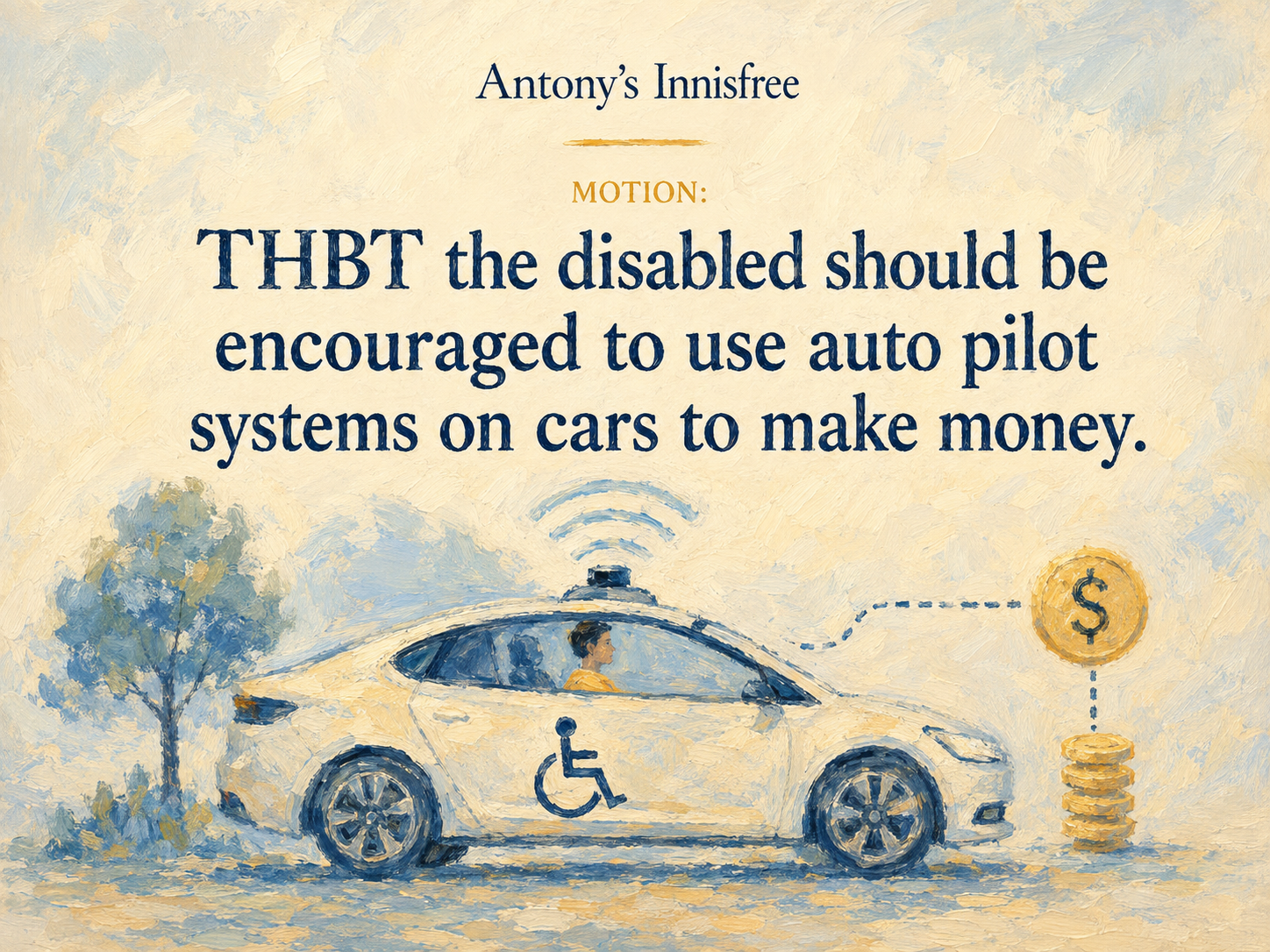
THBT the disabled should be encouraged to use auto pilot systems on cars to make money – Antony 's Innisfree
Read in 简体中文
动议分析 | 本院认为应鼓励残疾人利用汽车自动驾驶系统赚取收入
引言
几天前,一则去年的旧闻重新进入了我的视野:德克萨斯州一名残疾人正在使用特斯拉的完全自动驾驶(FSD)功能为 Uber 接单——以此维持生计,养活家人,在身体的局限之外重新找回了一份经济上的独立。
这是一幅令人动容的画面。技术在最理想的状态下,是一种伟大的平等力量——而自动驾驶系统似乎正在为身体受限的驾驶者实现这一点,打开那些曾经对他们紧闭的经济之门。然而,同一项技术在赋予残疾人方向盘的同时,也移除了健全驾驶者视为理所当然的某些安全屏障。当系统在时速一百公里时做出错误判断,谁来应对?
这种张力——赋权与风险敞口之间的博弈——正是这道动议要求我们回答的问题。
动议
本院认为应鼓励残疾人利用汽车自动驾驶系统赚取收入。
定义
辩论的一半成败在于对关键词的界定。
“残疾人”
我们将残疾人群体划分为两类:
- 轻度残疾:身体障碍不妨碍其在紧急情况下迅速反应的人群(例如:失去一根手指、单侧肢体活动受限)。他们保有在必要时手动接管车辆控制权的能力。
- 重度残疾:身体状况使其无法执行快速紧急操作的人群(例如:截瘫、双臂缺失)。在自动驾驶系统失效时,他们无法从物理层面介入。
这一区分并非武断——它是本动议中最核心辩论的结构性分水岭。
“鼓励”
这是动议中最容易被忽视的词。”鼓励”不等于”强制”,它意味着:
- 政策倡导:政府或机构公开支持残疾人使用自动驾驶车辆从事商业活动的权利。
- 无障碍支持:针对残疾人的补贴、监管豁免或专属驾照申请路径。
- 社会观念引导:使”残疾人可以通过技术参与零工经济”这一观念走向正常化。
关键在于:”鼓励”保留了个人选择权——它不强迫任何人上路。
“自动驾驶系统”
本动议所指为 SAE 第三级及以上自动驾驶功能(如特斯拉 FSD),即系统可处理大多数驾驶任务,但仍需人类在系统请求时随时接管。本动议不涉及完全无需人工干预的第五级无人驾驶车辆。
“赚取收入”
主要通过两种渠道:
- 个人网约车驾驶(Uber、滴滴):残疾人亲自驾驶车辆,按单计费。
- 运营自动驾驶车队公司:残疾人持有并管理一批自动驾驶车辆,提供类 Uber 服务,无需本人坐在每辆车内。
政策模型
政府方的案例建立在两条政策路径之上,按残疾程度分别设计。
路径一——个人网约车(仅限轻度残疾)
轻度残疾人可在以下条件下注册为网约车司机:
- 须持有有效驾驶证,证明具备在紧急情况下接管车辆的能力。
- 须具备在系统脱离或判断失误时手动接管的实际能力。
- 适用与健全驾驶者相同的监管框架,安全义务不予减免。
路径二——车队公司模型(适用于所有残疾程度)
包括重度残疾在内的所有残疾人,均可运营无人驾驶车队业务,但须满足:
- 完全遵守当地无人驾驶车辆相关法规。
- 强制配备在线驾驶员备援系统:经过训练的远程操作员,可在紧急情况下实时接管车辆。
- 知情投资同意:残疾创业者须充分了解这一新兴行业所涉及的资本要求、监管风险与潜在亏损风险。
支持动议的论点(政府方)
一、机会平等
多个司法管辖区的公司已在商业运营全自动无人驾驶车队(Waymo、文远知行等)。若企业能从自动驾驶技术中获利,便没有任何原则性理由将残疾人个体——这一或许从这项技术中受益更多的群体——排除在外。本动议并非开辟新的前沿,而是将一个既有前沿延伸至一个历史上被遗忘的群体。
二、经济赋权
对许多残疾人而言,尤其是重度肢体障碍者,传统就业路径极为有限。自动驾驶技术从根本上降低了通过交通运输赚取收入所需的身体依赖程度。德克萨斯那位 Uber 司机并非个例——他代表的是一类人,对他们而言,这项技术不是奢侈品,而是真正的生命线。鼓励使用这一路径,是在扩大经济自主权,而非限制它。
三、技术作为平衡器
自动驾驶技术的发展方向是更高的可靠性与更少的人工介入。在当下就鼓励残疾人进入这一市场——并辅以适当保障措施——将使他们在技术成熟后占据有利位置。以等待”完美”无人驾驶车辆为由延迟赋权,是一种将赋权无限期推后的家长式作风。
四、双重安全机制
政策模型并非单纯依赖对自动驾驶的信任。路径一保留人工接管能力,路径二强制配备在线驾驶员备援。这两种机制在不要求完全排除残疾参与者的前提下,有效应对了最严重的安全质疑。
反对动议的论点(反对方)
公正的分析必须呈现反对方最强有力的论点。
一、安全网存在漏洞
自动驾驶制造商自身的声明(以及大多数司法管辖区的法律)均已承认,系统并非万无一失。事故发生时,责任由人类操作者承担。对于轻度残疾驾驶者而言,”能及时反应”与”无法及时反应”之间的边界,在不同情境下极为模糊。对于路径二中的重度残疾驾驶者,在线驾驶员备援系统是一套尚未充分验证的紧急机制——仅仅是网络延迟(信号中断、传输延迟),就可能在毫秒级碰撞场景中使其形同虚设。反对方认为,”双重安全机制”听上去严密,实则掩盖了一个脆弱的技术现实。
二、”鼓励”可能掩盖剥削
零工经济有着将弱势工作者引入不稳定收入安排的惯常记录,受益最多的往往是平台,而非司机。”鼓励”残疾人将资本投入自动驾驶车队,或依赖网约车收入维持生计,可能在新的形态下复制这一结构。不对等性至关重要:健全司机的自动驾驶创业失败后,尚可转型为普通驾驶;重度残疾人则没有这条退路。下行风险在性质上属于不同的量级。
三、监管框架尚未就绪
要求轻度残疾驾驶者持有有效驾照,立刻产生一个内在矛盾:这一群体中的许多人,恰恰因为其残疾状况而无法取得或续签标准驾照。现行驾照体系是为健全驾驶者设计的,尚未适配残疾自动驾驶用户。在有效监管路径尚不存在的情况下”鼓励”,是在将人推入法律灰色地带。
四、谁来划定边界?
轻度/重度残疾的区分在分析层面清晰,在实操层面却难以执行。谁来判定某一具体个体的残疾程度是否允许充分的紧急应对?医疗分类系统?驾驶评估机构?这一问题的答案对安全性与可及性均有重大影响,而政府方并未提出可行的裁定机制。
辩论的权衡
本动议的核心冲突在于:这究竟是对残疾人的赋权,还是对他们不成比例的风险敞口?
政府方获胜的条件:
- 能够证明双路径模型确实按残疾严重程度提供了相称的保障措施。
- 能够证明经济收益是实质性的,且可被广泛获取。
- 能够证明安全机制足以主动管理残余风险,而非仅仅承认风险的存在。
反对方获胜的条件:
- 能够证明安全机制在现实技术约束下不足以应对风险。
- 能够证明能够切实、安全地受益于本动议的残疾人群体过于有限,不足以支撑将其定性为一项普遍性”鼓励”政策。
- 能够证明被推广的经济模式,受益方主要是科技平台,而非残疾人本身。
本文所有分析均基于作者的辩论框架,不构成法律或政策建议。
Introduction
A few days ago, a piece of news from last year resurfaced online: a disabled man in Texas was using Tesla’s Full Self-Driving (FSD) feature to drive for Uber — earning a living, supporting his family, reclaiming a degree of independence that his disability had taken from him.
It is a compelling image. Technology, at its best, is a great equaliser — and autopilot systems appear to be doing exactly that for drivers with physical limitations, opening economic doors that were once firmly closed. But the same technology that gives a disabled person the wheel also removes certain safeguards that able-bodied drivers take for granted. When the system makes a wrong call at 60 miles per hour, who responds?
That tension — between empowerment and exposure — is precisely what this motion asks us to resolve.
The Motion
THBT the disabled should be encouraged to use autopilot systems on cars to make money.
Definitions
Getting definitions right is half the debate.
“Disabled”
We divide the disabled population into two distinct groups:
- Mild disability: Individuals whose impairments do not prevent them from performing quick reactions in emergency situations (e.g., loss of a finger, reduced mobility in one limb). They retain the ability to manually take over vehicle control when necessary.
- Severe disability: Individuals whose conditions prevent them from executing rapid emergency responses (e.g., paralysis, loss of both arms). They cannot physically intervene when the autopilot fails.
This distinction is not arbitrary — it is the structural fault line that separates the two most critical debates in this motion.
“Encouraged”
This is the motion’s most underexamined word. “Encouraged” does not mean “mandated.” It implies:
- Policy advocacy: Governments or institutions publicly supporting disabled people’s right to use autopilot vehicles commercially.
- Accessibility support: Potential subsidies, regulatory accommodations, or specialised licensing pathways for disabled individuals.
- Social messaging: Normalising the idea that disabled people can and should participate in the gig economy through technology.
Crucially, “encouraged” preserves individual choice — it does not force anyone onto the road.
“Autopilot Systems”
We refer to SAE Level 3 and above autonomous driving features (e.g., Tesla FSD), which can handle most driving tasks but still require a human to be available to take over when the system requests it. We are not referring to fully driverless Level 5 vehicles that require no human intervention whatsoever.
“Make Money”
Primarily through two channels:
- Individual rideshare driving (Uber, DiDi): The disabled person operates a vehicle personally and earns per ride.
- Running an autonomous fleet company: The disabled person owns and manages a fleet of autopilot vehicles, providing Uber-like services without necessarily being physically present in each car.
The Policy Model
The Government’s case rests on two distinct pathways, calibrated to disability severity.
Pathway 1 — Individual Rideshare (Mild Disability Only)
Individuals with mild disabilities may register as rideshare drivers under the following conditions:
- Must hold a valid driving licence, demonstrating the ability to take over control in emergencies.
- Must be physically capable of manual takeover when the system disengages or errs.
- Operates under the same regulatory framework as able-bodied autopilot users, with no reduced safety obligations.
Pathway 2 — Fleet Company Model (All Disability Groups)
Disabled individuals — including those with severe disabilities — may run an autonomous vehicle fleet business, subject to:
- Full regulatory compliance with local driverless vehicle laws.
- A mandatory online driver backup system: trained remote operators who can connect to vehicles in real time during emergencies.
- Informed investment consent: prospective disabled entrepreneurs must be made fully aware of the capital requirements, regulatory risks, and potential for financial loss in this nascent industry.
Arguments for the Motion (Government)
1. Equality of Opportunity
Companies already operate fully driverless vehicle fleets commercially in multiple jurisdictions (Waymo, WeRide, etc.). If corporations can profit from autonomous vehicle technology, there is no principled reason why disabled individuals — who may benefit even more from it — should be excluded. The motion does not create a new frontier; it extends an existing one to a group that has historically been left behind.
2. Economic Empowerment
For many disabled people, especially those with severe physical impairments, traditional employment pathways are severely limited. Autopilot technology uniquely reduces the physical dependency required to generate income through transportation. The Texas Uber driver is not an edge case — he represents a category of people for whom this technology is not a luxury, but a genuine lifeline. Encouraging this pathway expands economic agency rather than restricting it.
3. Technology as an Equaliser
The trajectory of autopilot technology is toward greater reliability and reduced driver intervention. Encouraging disabled people to participate in this market now — with appropriate safeguards — positions them advantageously as the technology matures. Waiting for “perfect” autonomous vehicles before extending access is a form of paternalism that delays empowerment indefinitely.
4. Dual Safety Layers
The model does not rely on faith in autopilot alone. Pathway 1 retains human override capability. Pathway 2 mandates remote driver backup. These mechanisms address the most serious safety objections without demanding the wholesale exclusion of disabled participants.
Arguments against the Motion (Opposition)
A fair analysis must present the strongest version of the Opposition’s case.
1. The Safety Net Has Holes
Autopilot systems, by manufacturers’ own admission and by law in most jurisdictions, are not failsafe. Liability in the event of an accident falls on the human operator. For mild-disabled drivers, the boundary between “can react in time” and “cannot” is thin and situationally variable. For severe-disabled drivers in Pathway 2, the online backup system is an unproven emergency mechanism — network latency and signal drops alone could render it useless in a split-second collision scenario. The Opposition argues that “dual safety layers” sounds robust but masks a fragile technical reality.
2. Encouragement Can Mask Exploitation
The gig economy has a documented history of drawing vulnerable workers into unstable income arrangements that benefit platforms far more than drivers. “Encouraging” disabled people to invest capital in autonomous fleets, or to depend on rideshare income as a primary livelihood, may reproduce this dynamic in a new form. The asymmetry matters: if a non-disabled driver’s autopilot venture fails, they can pivot to conventional driving. A severely disabled person cannot. The downside risk is categorically worse.
3. The Regulatory Framework Is Not Ready
Requiring mild-disabled drivers to hold valid driving licences creates an immediate contradiction: many individuals in this category may be unable to obtain or renew a standard licence precisely because of their disability. The licensing system was designed for able-bodied drivers and has not been adapted for disabled autopilot users. Encouraging without a functioning regulatory pathway is encouraging people into a legal grey area.
4. Who Decides the Threshold?
The mild/severe disability distinction is analytically clean but practically difficult to implement. Who determines whether a given individual’s condition allows adequate emergency response? Medical assessors? Driving examiners? The answer has enormous implications for both safety and access, and the Government has proposed no workable adjudication mechanism.
Weighing the Debate
The central clash is: Does this motion empower the disabled, or does it expose them to disproportionate harm?
The Government wins if it can demonstrate that:
- The dual-pathway model provides proportionate safeguards calibrated to disability severity.
- The economic gains are substantial and broadly accessible.
- The safety mechanisms are robust enough to actively manage residual risk — not merely acknowledge it.
The Opposition wins if it can demonstrate that:
- The safety mechanisms are insufficient given real-world technical constraints.
- The population of disabled people who can realistically and safely benefit is too small to justify calling this a general policy of “encouragement.”
- The model being promoted primarily serves tech platforms rather than disabled people themselves.
All analysis reflects the author’s debating framework and does not constitute legal or policy advice.
Leave a Reply