

Full Transcript
Transcription note: This is a machine-generated transcript produced from the complete 19:25 audio. Obvious speech-recognition errors were lightly corrected, while fillers, repetitions, hedging, and the original order of speech were retained. Speaker labels are omitted because both voices are mixed into the same audio channels, making automatic diarization unreliable. This is a close transcript, but not a human-certified forensic transcript.
Audio duration: 19:25
Language: English
00:00–04:00
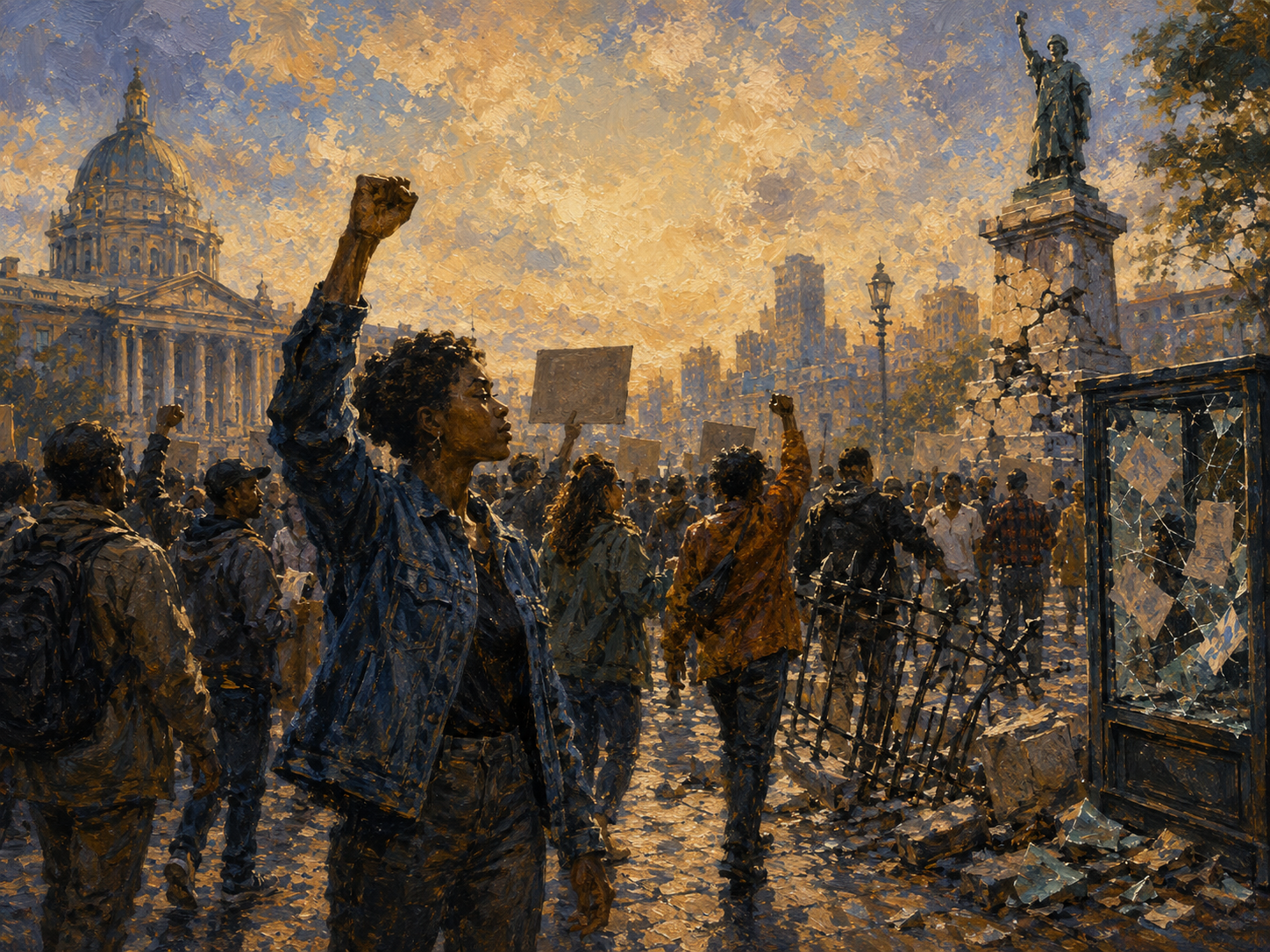
[00:00–00:08] Welcome to the debate, imagine a slow water leak starting in the basement of a large house.
[00:08–00:13] The homeowner spots it, but instead of, you know, calling a plumber to fix the foundational
[00:13–00:16] pipes, they just put a bucket under it.
[00:16–00:17] Right, just a temporary fix.
[00:17–00:18] Exactly.
[00:18–00:21] It’s a problem, sure, but it is entirely contained.
[00:21–00:28] The homeowner can just step around it, walk upstairs, and carry on with their life.
[00:28–00:33] But what happens when that leak is actively undermining the foundation, and the people living
[00:33–00:38] in the basement are literally drowning, while the people upstairs remain perfectly dry.
[00:38–00:42] Yeah, that, that inequality of urgency.
[00:42–00:43] Right.
[00:43–00:48] If shouting up the stairs doesn’t work, at what point are the people in the basement justified
[00:48–00:53] in breaking a water main to deliberately flood the living room, just to force the homeowner
[00:53–00:56] to finally fix the issue?
[00:56–01:00] That question of escalation is, well, it’s one of the most perilous calculations any
[01:00–01:02] marginalized group has to make.
[01:02–01:07] Today, we are exploring a deeply challenging question drawn from our source material regarding
[01:07–01:09] the mechanics of social change.
[01:09–01:15] Namely, when peaceful protests, petitions, and negotiations have repeatedly failed, should
[01:15–01:20] civil rights movements use limited, targeted violence to advance their cause?
[01:20–01:25] And before we go any further, I mean, we really need to immediately establish the strict
[01:25–01:30] parameters of the material we are discussing today, because the word violence carries immense
[01:30–01:32] historical and emotional baggage.
[01:32–01:36] Absolutely, the definition is really the hinge of this entire analysis.
[01:36–01:41] For our purposes today, violence explicitly means the deliberate and targeted destruction
[01:41–01:43] of non-essential public or state property.
[01:43–01:45] Strictly, property.
[01:45–01:52] Yes, it fundamentally and strictly excludes any harm to civilians, to protesters, or to public
[01:52–01:59] workers. It also entirely excludes attacks on essential services, hospitals, emergency response
[01:59–02:04] infrastructure, or really anything whose destruction would endanger ordinary people.
[02:04–02:09] Right, we are talking purely about the destruction of property to force a political reckoning.
[02:09–02:16] Yes, and I will argue that this kind of controlled, limited escalation is a necessary strategic
[02:16–02:22] tool. When governments repeatedly ignore peaceful demands, targeted property destruction forces
[02:22–02:27] them to address ignored grievances, and, you know, it provides crucial bargaining power to the
[02:27–02:33] politically weak. And I will be arguing against that approach. I take the position that abandoning
[02:33–02:40] peaceful methods, even if perfectly restricted to non-essential property, hands the state the exact
[02:40–02:47] justification it needs to deploy its massive coercive apparatus. Ultimately, I argue it fails the
[02:47–02:52] single most important metric from our text. It just does not make meaningful civil rights reform
[02:52–02:57] more likely. Well, let’s ground this in the core problem marginalized groups face.
[02:57–03:02] Listeners might hear property damage and immediately picture chaos, but we have to isolate the
[03:02–03:07] intent here. The reality is that governments have incredibly weak incentives to respond to
[03:07–03:12] civil rights violations when the affected group is a politically vulnerable minority. Sure.
[03:12–03:18] If solving an issue is politically or economically costly and the people suffering lack electoral
[03:18–03:22] power or capital, the state has absolutely no organic reason to change the status quo.
[03:23–03:29] That institutional inertia is undeniably real. I’ll give you that. The machinery of the state is
[03:29–03:34] designed to maintain stability, which invariably means maintaining whatever the current
[03:34–03:39] power dynamic happens to be. Right. And because of that inertia, governments have learned how
[03:39–03:45] to seamlessly absorb peaceful protests. They treat peaceful marches as something they can simply
[03:45–03:51] wait out. Yeah, they just let it pass. Exactly. Authorities will acknowledge the demonstrators. Maybe,
[03:51–03:56] you know, issue a sympathetic press statement, promise to form an exploratory committee to study
[03:56–03:59] the issue. Right. The classic exploratory committee.
04:00–08:00
[04:00–04:05] and then they just wait for the media cycle to move on. The fundamental injustice remains untouched.
[04:05–04:11] This is where the thesis of our material comes into play. Targeted violence against—strictly
[04:11–04:17] against—non-essential property turns an issue that is politically easy for the state to postpone
[04:17–04:23] into an issue that creates immediate, visible, and unavoidable administrative costs.
[04:23–04:30] I deeply understand the frustration of having peaceful advocacy ignored decade after decade.
[04:30–04:37] It is frankly a profound systemic injustice, but we have to evaluate the efficacy of this strategy
[04:37–04:42] based on our core metric from the material. Which is forcing meaningful reform.
[04:42–04:48] Exactly. Does this action actually force meaningful reform? I argue that it does not.
[04:48–04:55] The moment a movement crosses the threshold from peaceful assembly into property destruction,
[04:55–05:01] they give the government a golden, unassailable pretext to shift the entire narrative.
[05:01–05:05] A pretext for what, though? Well, the conversation is no longer about civil rights.
[05:05–05:12] It instantly becomes a conversation about law and order. We must remember that modern states possess
[05:12–05:18] immense coercive power. We are talking about sweeping anti-terrorism laws,
[05:18–05:24] surveillance networks, and militarized police forces. Sure, but escalating to violence,
[05:24–05:29] even if a movement is just breaking windows at an empty tax office, invites an aggressive
[05:29–05:35] police retaliation that can effortlessly crush a movement before any negotiation ever takes place.
[05:35–05:40] I see why you think that, but let me give you a different perspective on what the text calls
[05:40–05:45] “the calculus of attention.” When a movement escalates to limited sabotage,
[05:45–05:51] the disruption becomes physically impossible for the media and the authorities to ignore.
[05:51–05:57] Right, they definitely get attention. Think about it mechanically. If 50 people hold signs outside
[05:57–06:02] a government building, the evening news might not even send a camera crew. But if those same 50
[06:02–06:07] people safely dismantle the security gates of that government building in the dead of night,
[06:07–06:11] it is front page news globally. I come at it in a completely different way, though.
[06:11–06:16] Yes, you get the front page, but what is the headline? The headline isn’t a thoughtful
[06:16–06:22] exploration of their civil rights grievances. Well, the headline is vandals attack state property.
[06:22–06:27] But that headline forces a structural reaction. The authorities have to step up to a podium
[06:27–06:32] and publicly explain why this movement exists and what they are going to do to stop it.
[06:32–06:35] The political and administrative costs rise dramatically.
[06:35–06:39] Do they, though? Yes. Think back to our opening metaphor.
[06:39–06:43] Peaceful protests are the slow leak in the basement that the homeowner ignores.
[06:43–06:48] Targeted property destruction is the flooded living room. It forces immediate action.
[06:48–06:53] But you’re assuming the homeowner’s first instinct is to call a plumber to fix the foundational pipes.
[06:53–06:56] History tells us that when the state is the homeowner,
[06:56–07:00] their first instinct is to aggressively punish the person holding the wrench.
[07:00–07:06] Not always. Let’s look at a concrete historical example from the material to ground this.
[07:06–07:10] Think of the suffragette movement in the UK in the early 20th century.
[07:10–07:16] When they shifted from peaceful marches to a militant campaign of smashing windows on Oxford Street,
[07:16–07:19] the state didn’t immediately grant women the right to vote.
[07:19–07:21] They definitely faced backlash, yes.
[07:21–07:28] The state passed the draconian Cat and Mouse Act, brutally arresting and force-feeding women in prison.
[07:28–07:33] By escalating the property destruction, you are triggering the state’s security mandate.
[07:33–07:38] You expose vulnerable activists to lengthy prison sentences and immense physical harm,
[07:38–07:40] risking the complete destruction of the movement.
[07:40–07:45] I’m not convinced by that line of reasoning because it ignores the asymmetry of the moral high ground.
[07:45–07:51] And honestly, the suffragettes are actually the perfect example of this mechanism working over time.
[07:51–07:51] How so?
[07:51–07:58] Remember our strict parameter, the movement deliberately avoids harming civilians.
[07:58–07:59] Because the suffragettes took immense
08:00–12:00
[08:00–08:05] care to target property, not people, the state’s response—that brutal force-feeding
[08:05–08:11] you just mentioned—was a disproportionately violent repression against people who merely
[08:11–08:12] broke glass.
[08:12–08:14] It was brutal, certainly.
[08:14–08:17] And that overreaction ultimately backfired on the government.
[08:17–08:21] It exposed the inherent cruelty of the state to the broader public.
[08:21–08:25] We don’t need every member of society to approve of the protesters’ tactics.
[08:25–08:28] No, but you need them not to demand your arrest.
[08:28–08:33] We just need the government’s violent overreaction to create so much political instability
[08:33–08:39] and public outrage that early negotiation becomes comparatively more attractive than continuing
[08:39–08:41] an endless cycle of repression.
[08:41–08:47] I won’t deny that watching a state brutalize its citizens can shift public sympathy.
[08:47–08:51] But that is a terrifying gamble.
[08:51–08:55] You are essentially hoping that the state beats your activist so severely in front of the
[08:55–09:00] cameras that the public gets disgusted with the state before the movement is entirely eradicated.
[09:00–09:03] It’s about revealing the violence that already exists.
[09:03–09:08] In reality, though, a frightened public often just demands more order.
[09:08–09:11] And this leads us to the broader strategic question of leverage.
[09:11–09:15] Leverage is exactly where we need to focus, because survival isn’t the goal; forcing
[09:15–09:16] a negotiation is.
[09:16–09:19] Politically weak groups face a fundamental bargaining deficit.
[09:19–09:23] They do not have wealth, they do not fund lobbying firms, and they are usually outnumbered
[09:23–09:24] at the ballot box.
[09:24–09:27] Right, they lack conventional power.
[09:27–09:28] Exactly.
[09:28–09:33] If a peaceful movement asks for negotiations, and the government knows that refusing will only
[09:33–09:38] result in another peaceful march next week, the government concedes nothing.
[09:38–09:41] But the credible threat of future escalation changes the math.
[09:41–09:44] I’m sorry, but I just don’t buy that calculation.
[09:44–09:45] Let me tell you why.
[09:45–09:50] You are treating the state like an isolated, rational actor, weighing the cost of a broken
[09:50–09:53] window against the cost of a civil rights bill.
[09:53–09:56] But states govern by precedent.
[09:56–10:00] And precedent is exactly what they are trying to protect by ignoring the weak.
[10:00–10:04] Yes, which is why your leverage mechanism fails in practice.
[10:04–10:10] If a government negotiates under the threat of sabotage, they’re sending a glaring signal
[10:10–10:12] to every other aggrieved group in the country.
[10:12–10:18] They’re essentially saying, if you want us to listen to your demands, go disable a non-essential
[10:18–10:24] electrical transformer, but they would be incentivizing sabotage across the board.
[10:24–10:30] Therefore the state is highly likely to refuse negotiations entirely just to avoid setting
[10:30–10:31] that dangerous precedent.
[10:31–10:34] Instead, they bring down the hammer.
[10:34–10:39] By abandoning a strict commitment to peaceful methods, the movement removes its most powerful,
[10:39–10:42] moral, and strategic shield.
[10:42–10:46] That’s an interesting point about precedent, though I would frame the concept of certainty
[10:46–10:47] differently.
[10:47–10:52] By holding onto that moral shield, what do you actually achieve strategically?
[10:52–10:55] You’re preventing the state from labeling you a terrorist.
[10:55–10:57] But let me ask you directly.
[10:57–11:01] By promising the government that resistance will never, under any circumstances, escalate
[11:01–11:05] beyond peaceful methods, aren’t you giving the state absolute certainty that continued
[11:05–11:08] neglect will forever remain manageable?
[11:08–11:13] You are giving the state the assurance that you will not act criminally, which, frankly,
[11:13–11:14] keeps you out of prison.
[11:14–11:20] You are giving them a guarantee that they can ignore you forever without consequence.
[11:20–11:25] Let’s leave the leaking basement behind for a second and look at a labor dynamic.
[11:25–11:29] Imagine workers at a factory who are facing lethal conditions.
[11:29–11:30] Okay.
[11:30–11:35] If they just stand outside with signs, the factory owner hires replacement workers and ignores
[11:35–11:36] them.
[11:36–11:41] The owner has certainty, but if the workers threaten to safely dismantle the machinery
[11:41–11:48] itself, ensuring no profit can be made until conditions improve, the owner has to negotiate.
[11:48–11:51] But that’s a private business, not the state.
[11:51–11:53] The dynamic is the same.
[11:53–11:58] Under your framework, the movement effectively says, regardless of how long you suppress
[11:58–12:00] us: we promise we will
12:00–16:00
[12:00–12:02] never make this truly difficult for you.
[12:02–12:06] That commitment might be comforting to outside observers, but strategically it entirely
[12:06–12:10] removes the one piece of leverage a powerless group has.
[12:10–12:13] My side removes the government’s certainty.
[12:13–12:19] But you are replacing the certainty of being ignored with the certainty of being prosecuted
[12:19–12:21] as a domestic terror threat.
[12:21–12:26] Let’s look at how governments handle what political scientists call the “radical flank
[12:26–12:27] effect.”
[12:27–12:28] Sure.
[12:28–12:29] Let’s look at it.
[12:29–12:34] When a movement splinters into a peaceful wing and a militant wing that engages in sabotage, the state
[12:34–12:38] rarely says, “Oh, the machinery’s at risk.
[12:38–12:40] We better talk to the moderate union leaders.”
[12:40–12:41] Sometimes they do.
[12:41–12:47] Usually, they use the actions of the militants to justify passing sweeping conspiracy laws.
[12:47–12:53] They freeze the bank accounts of the entire movement, moderate and militant alike.
[12:53–12:58] The leverage you think you are building is actually just handing the state the legal justification
[12:58–13:01] to censor and detain your leadership.
[13:01–13:06] I think we have to shift our perspective here, from purely tactical maneuvering to the
[13:06–13:12] underlying principled framing of this debate, because what your position essentially demands
[13:12–13:17] is that oppressed people adhere to a principle of perfect respectability.
[13:17–13:20] Well, that requires some unpacking.
[13:20–13:24] What exactly do you mean by perfect respectability in this context?
[13:24–13:29] It is this pervasive idea that oppressed people have an absolute moral obligation to
[13:29–13:37] remain perfectly polite, to protest only in designated free speech zones, and to remain
[13:37–13:41] entirely convenient to society before their right will be taken seriously.
[13:41–13:42] I see.
[13:42–13:45] Let’s look at the profound hypocrisy of that demand.
[13:45–13:51] Civil rights movements are resisting systems in which the government already exercises immense
[13:51–13:54] coercive power over them every single day.
[13:54–14:02] The state uses courts, armed police, surveillance, and prisons to enforce unjust laws.
[14:02–14:08] It is fundamentally unreasonable to impose an absolute moral obligation on vulnerable
[14:08–14:14] people to remain perfectly peaceful indefinitely regardless of how persistently their
[14:14–14:17] basic rights are denied by a violent state.
[14:17–14:21] That’s a compelling argument regarding fairness, I’ll admit.
[14:21–14:25] But have you considered that demanding non-violence is not about moral purity at all?
[14:25–14:26] How so?
[14:26–14:29] I completely concede that the double standard is infuriating.
[14:29–14:33] It is deeply unfair to demand that oppressed people endure state violence with a smile
[14:33–14:35] and a peaceful placard.
[14:35–14:39] But we have to return strictly to the metric established by our source material.
[14:39–14:43] Success is about achieving reform, not winning moral victories.
[14:43–14:47] But forcing the issue into the public consciousness by disrupting the system is the first
[14:47–14:49] step toward reform.
[14:49–14:54] Is it? Even if targeted violence against property is theoretically proportionate to the
[14:54–14:56] state’s abuses?
[14:56–15:02] We have to look at the practical reality of who holds power, but deliberately alienating
[15:02–15:06] the wider public, specifically the moderate majority who currently benefit from the status
[15:06–15:10] quo, might feel like a justified rejection of respectability politics.
[15:10–15:14] But practically, it ensures the movement remains politically isolated.
[15:14–15:16] I disagree that it ensures isolation.
[15:16–15:21] An isolated movement is easily suppressed by the state’s vast public institutions.
[15:21–15:25] You can be entirely morally justified in dismantling the factory machinery, but if doing
[15:25–15:30] so means you get locked in a cell and the labor laws never change, you have failed your
[15:30–15:31] constituents.
[15:31–15:35] But the historical reality is that without the friction generated by that disruption, the law
[15:35–15:37] was never going to change anyway.
[15:37–15:38] That’s a strong claim.
[15:38–15:41] The peaceful marches were already failing.
[15:41–15:44] The petitions were already being thrown in the trash.
[15:44–15:49] The movement was already politically isolated by virtue of being a marginalized minority.
[15:49–15:51] The limited escalation doesn’t create the isolation.
[15:51–15:57] You see, it forces the isolation out into the open where society is forced to confront it.
[15:57–15:59] It forces a confrontation, yes.
[15:59–15:59] But a confrontation—
16:00–19:25
[16:00–16:04] between a marginalized, politically weak minority and the fully funded,
[16:04–16:10] coercive apparatus of a modern state is an incredibly asymmetrical battle.
[16:10–16:11] It is.
[16:11–16:15] When you abandon nonviolent discipline, you are fighting the state on the very terrain
[16:15–16:20] where the state is strongest, the deployment of physical force.
[16:20–16:24] Not physical force against people, physical disruption of systems.
[16:24–16:26] There is a vast difference.
[16:26–16:31] Environmental protesters, for example, block a railway, or dismantle logging equipment
[16:31–16:33] without hurting anyone.
[16:33–16:37] They aren’t trying to outgun the military, sure, they aren’t using guns.
[16:37–16:43] They are making the financial and administrative costs of running the unjust system higher
[16:43–16:45] than the cost of reforming it.
[16:45–16:49] And in response, the state just increases the budget for the police to guard the railway,
[16:49–16:54] passes the financial costs onto the taxpayer, and labels the protesters as saboteurs
[16:54–16:56] to alienate them from the public.
[16:56–17:01] But eventually, the state can absorb the financial cost of broken property far longer than
[17:01–17:06] a marginalized movement can absorb the human cost of having its most dedicated members
[17:06–17:07] imprisoned.
[17:07–17:10] Which brings us to the fundamental tension we’ve been circling today.
[17:10–17:15] As we analyze the architecture of social change, we are left with two highly imperfect paths
[17:15–17:17] when conventional systems fail.
[17:17–17:18] Extremely imperfect.
[17:18–17:24] On my side, controlled, limited escalation breaks the cycle of governmental neglect.
[17:24–17:29] It creates the necessary administrative costs, and the critical bargaining leverage required
[17:29–17:34] to force meaningful reform for people who are otherwise politically defenseless.
[17:34–17:37] It removes the government’s luxury of infinite postponement.
[17:37–17:42] And on my side, I maintain that crossing that line into violence, even when rigorously limited
[17:42–17:47] to non-civilian property damage, provides the state with the exact pretext it seeks to
[17:47–17:50] deploy its coercive apparatus.
[17:50–17:55] It allows the government to entirely change the subject from civil rights to public order,
[17:55–17:59] risking the very survival of the movement for a theoretical bargaining advantage that rarely
[17:59–18:01] materializes in reality.
[18:01–18:06] Yet despite this fundamental disagreement on tactics, there is a profound convergence
[18:06–18:10] in how we understand the environment these movements operate within.
[18:10–18:15] We both clearly acknowledge that governments frequently and unjustly ignore the peaceful advocacy
[18:15–18:17] of weak minorities.
[18:17–18:20] The system is heavily weighted toward institutional inertia.
[18:20–18:21] Absolutely.
[18:21–18:25] The mechanisms of power rarely concede anything without friction.
[18:25–18:30] And more importantly, we also completely agree on the strict parameters of harm.
[18:30–18:31] Yes.
[18:31–18:36] If any escalation is ever to occur, it must draw an absolute and inviolable line at protecting
[18:36–18:39] civilian lives and essential infrastructure.
[18:39–18:45] The moment a movement harms ordinary people, it abandons its civil rights mandate entirely.
[18:45–18:48] It loses all legitimacy and becomes something else entirely.
[18:48–18:52] This leaves us reflecting on the deep complexity of social reform.
[18:52–18:53] It’s never simple.
[18:53–18:59] Marginalized groups face agonizing choices when conventional political avenues are sealed
[18:59–19:00] shut.
[19:00–19:05] Mechanics of state power, the psychology of public attention, and the desperate physics of civilian
[19:05–19:10] resistance offer so much more to explore than a simple binary of right and wrong.
[19:10–19:14] We leave you today not with a definitive answer, but with a challenge to consider the realities
[19:14–19:15] of leverage.
[19:15–19:17] A very difficult challenge.
[19:17–19:22] When a system is structurally designed to ignore the powerless, how much friction is required
[19:22–19:24] to make the invisible visible?
[19:24–19:25] Thank you for joining us.
Leave a Reply