
Antony’s Innisfree · BP Debate Union · Motion Analysis Series
Podcast Version

THBT Feminists in Western Liberal Democracies Should Adopt Conciliatory Rather Than Confrontational Approaches in Their Advocacy – Antony 's Innisfree
A Note on This Series
Motion Analysis pieces present one side of a competitive debate motion in full analytical form — the strongest version of the case, with its historical grounding, internal logic, and genuine weaknesses laid out together. These are not personal positions. The goal is to think more carefully about difficult arguments, not to endorse them.
Framing the Motion
Before building the case, two definitional decisions need to be made explicit, because they determine almost everything.
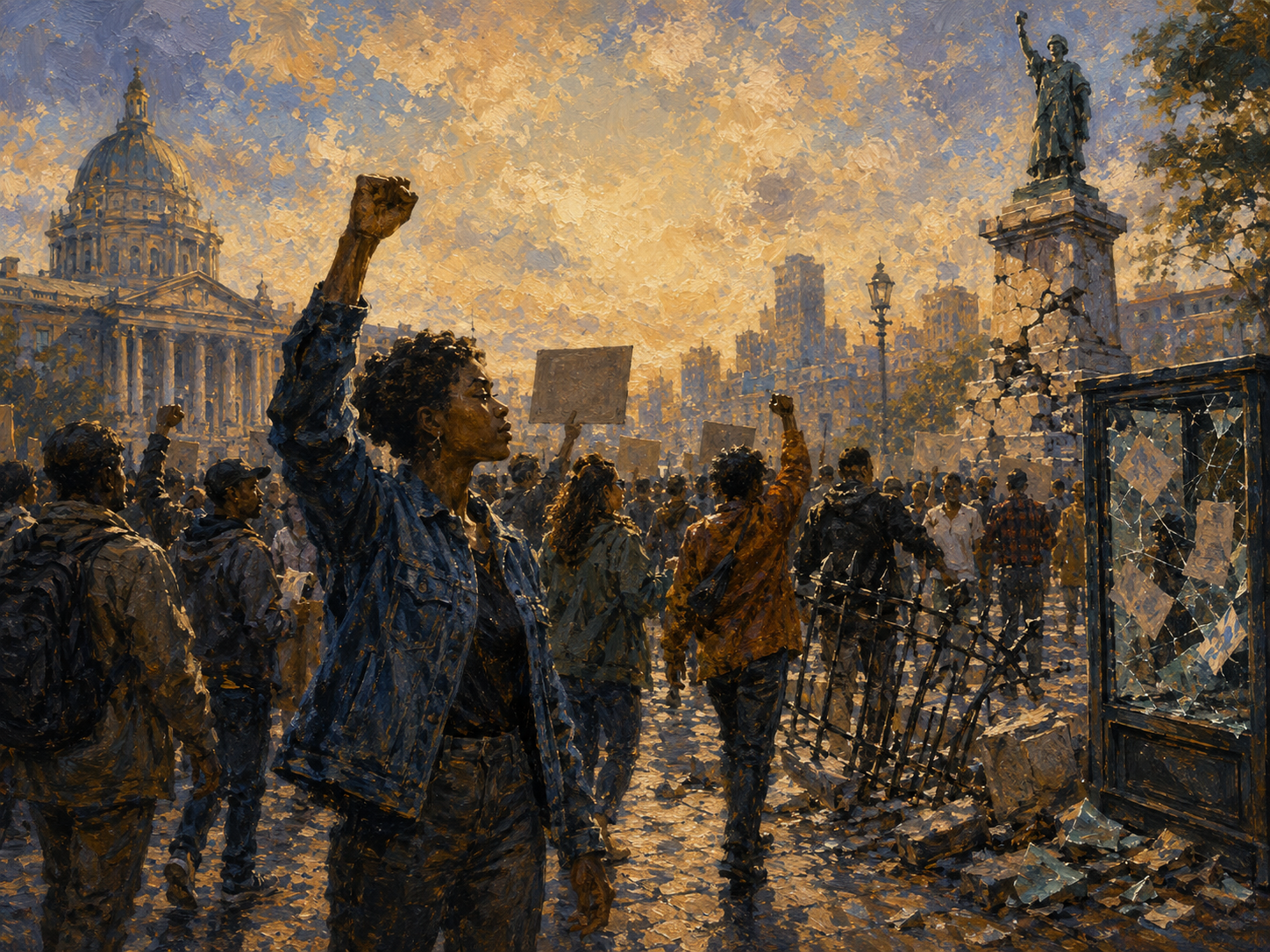
On violence: The Government restricts its defence to deliberate, targeted destruction of non-essential public or state property. Attacks on persons are excluded. Attacks on essential infrastructure — hospitals, utilities, emergency services — are excluded. This is not an aesthetic restriction. It is a structural one: violence that harms civilians generates opposition and political permission for repression; violence that harms property creates costs without creating victims. The distinction is load-bearing.
On “advance its cause”: The metric is whether meaningful reform becomes more likely — not whether the movement becomes more popular, generates more media coverage, or is viewed more sympathetically. A movement can win public relations and lose the underlying cause. The Government case is indifferent to optics; it cares about incentive structures.
One further thing: the Government does not argue that violence should be the first response, or that it is always effective. The motion’s real domain covers two distinct types of cases, and the Government needs to be explicit about which it is defending. The first is where the violation is known and partially acknowledged but systematically deprioritised — the government has chosen to wait the movement out. The second is where the violation is actively concealed or structurally invisible to the public — not because governments are ignoring what everyone can see, but because the public has been prevented from seeing it at all. These two scenarios share a common feature: peaceful advocacy cannot reach the people or institutions with the power to act. They also call for different mechanisms, and conflating them is one of the easiest ways for the Government to lose analytical clarity.
The Government Case
I. The Problem of Structured Neglect
The Government case needs to win two distinct versions of this problem.
The first is where the violation is known — at least partially — and systematically deprioritised anyway. Governments have weak incentives to act when the affected group lacks electoral power, when reform is politically costly, when the institutions that would need to change are also the institutions that benefit from current arrangements, or when governments have learned that protest movements exhaust themselves without forcing meaningful change. Under these conditions, peaceful advocacy can operate indefinitely without altering the decision-maker’s calculus. A government can issue statements, promise reviews, convene commissions, and wait. The underlying problem continues. The attention moves elsewhere.
The British suffragette movement is instructive here. By 1903, peaceful suffrage advocacy had been active for over thirty years. The 1866 petition to Parliament, signed by nearly 1,500 women, had produced nothing. Mill’s amendment to the Representation of the People Act 1867 failed. Fifteen subsequent parliamentary bills failed. When the WSPU escalated — window-smashing campaigns, postal box arson, hunger strikes — the calculus shifted. The Representation of the People Act 1918 followed. Historians disagree about the causal weight of militancy versus wartime service and shifting public opinion, and that disagreement is worth taking seriously. But the structural point survives: the WSPU made the cost of continued neglect visible in a way that petitions had not.
The second scenario is structurally different, and in some ways harder for peaceful advocacy to address. Here, the problem is not that the government is ignoring visible dissent. It is that the public has been prevented from knowing the problem exists at all. Governments may control, or tolerate control over, the channels through which information about the violation would normally spread — state media, restricted internet access, institutional secrecy around surveillance practices or data collection. Under these conditions, peaceful advocacy faces a more fundamental obstacle: it cannot generate public pressure because it cannot reach the public. The mechanism of the violation is also the mechanism that blocks the peaceful response to it.
Where the civil right at stake is the right to access information freely — a right that depends precisely on the openness of communications infrastructure — this dynamic becomes particularly acute. Targeted disruption of the infrastructure that enables concealment is not simply protest; it simultaneously forces the problem into a public consciousness that peaceful channels have been denied access to. The threshold for escalation in this scenario may be structural rather than temporal — not “after sustained peaceful failure over time” but “when the channels for peaceful advocacy are themselves the object of the violation.”
In both scenarios, the Government’s core claim is the same: targeted disruption either makes ignoring a known problem more costly than addressing it, or makes an unknown problem visible for the first time. These are different mechanisms serving the same end, and the Government should be prepared to identify which scenario it is in.
II. Leverage Without Conventional Power
The second argument is about bargaining rather than attention.
Civil rights movements often exist precisely because the affected people lack conventional political power. They may not control elections, major institutions, significant wealth, or access to media. This creates a structural problem: a government has very little reason to negotiate seriously with a movement if ignoring it carries almost no cost. A peaceful movement can ask for negotiation, and if the government believes that refusal will produce another peaceful demonstration next week, there is no particular reason to concede anything.
The ability to escalate changes this calculation. It creates a reason for governments to negotiate with moderate representatives of the movement now — because doing so might prevent escalation later. The strategic value lies not necessarily in large-scale violence, but in the credible possibility of escalation. The threat needs to be believable. Credibility, not scale, is what generates leverage.
The African National Congress provides the clearest historical anchor for this argument. After 49 years of peaceful resistance — petitions, strikes, legal challenges, non-violent civil disobedience — the Sharpeville massacre in 1960 killed 69 people and the ANC was banned. The following year, Umkhonto we Sizwe was formed as the ANC’s armed wing. Mandela’s reasoning at the time was explicit: he did not believe the armed struggle could defeat the apartheid state militarily. Its function was to demonstrate that the costs of maintaining the status quo were not zero. The negotiated transition of 1994 came after decades of combined pressure, and it is difficult to argue that the armed struggle was irrelevant to the terms and timeline of that transition.
This is the Government’s most defensible claim: not that violence wins, but that it creates leverage for movements that otherwise have almost none. Opposition needs to engage with this directly, not only with cases where peaceful movements succeeded under more favourable conditions.
Key Clashes
These are the genuine tensions in the Government case — the arguments that the Opposition will press, and that any serious analysis of the motion needs to address.
The threshold problem. The Government’s case depends on a threshold condition: escalation is justified only after peaceful methods have consistently failed. But this condition is contestable in nearly every real case. Who determines when the threshold has been reached? If any movement can declare its threshold met, the limiting principle loses its function. The Government needs a more precise account of what “repeated and systematic failure” looks like, and who adjudicates it. This is the sharpest Opposition clash.
The backfire risk. Escalation does not always generate political pressure on governments — sometimes it consolidates public opinion against the movement and provides political cover for repression. There is a reasonable historical argument that some of the WSPU’s more extreme actions alienated Liberal Party supporters who were the suffragettes’ most plausible institutional allies. The question is structural: under what conditions does escalation increase the cost of neglect versus increase the social permission for crackdown? The Government’s answer lies in the deliberate restriction of violence itself. By limiting disruption strictly to non-essential property — explicitly excluding persons, essential services, and infrastructure ordinary people depend on — the movement preemptively removes the government’s strongest justification for violent repression. State violence against protesters who have harmed no one is politically costly to defend publicly; state violence against people who have attacked hospitals or transit systems is far easier to justify. The Government’s self-imposed limitations are therefore not only a moral constraint. They are a strategic one: they force the government into a position where escalating to repression is the choice that requires public justification, not the protest itself. Whether this discipline holds under real conditions — when individual actors within a movement may not share the same restraint — remains a genuine open question that the Government needs to address directly.
The Gandhi problem. Non-violent movements have produced major transformations — Gandhi, King, the Velvet Revolution. The Opposition will use these cases. The Government’s best response is not to deny the examples but to identify the conditions that made them work: governments susceptible to reputational pressure, international visibility, a press that reports freely, some economic leverage by the affected group. The motion’s real domain is precisely the cases where these conditions are absent. In authoritarian contexts, with invisible populations, under governments with limited accountability to international opinion, the moral weight of peaceful protest may simply not be enough. Distinguishing these contexts is the Government’s responsibility.
What “non-essential” actually means. The definitional restriction to non-essential property is doing significant work in the Government case, but the category is not self-defining. Critical infrastructure is obvious, but much of the property that property-destruction campaigns actually target — government offices, transport systems, symbols of institutional power — sits in contested territory. The Government needs to either tighten this definition or acknowledge that its application will always be disputed.
For Discussion
These questions don’t have easy answers. They’re worth arguing over.
On credibility: A threat of escalation is only strategically useful if the government believes the movement will act on it. But if the movement never actually uses violence — only threatens — governments learn to discount the threat over time. Does the bargaining argument therefore require some actual violence to remain credible? If so, is the Government’s “last resort, minimal, controlled” framing coherent in practice, or does the logic of credibility keep pushing toward more?
On institutional effects: Even if a specific movement benefits from escalation in the short term, does normalising political violence as a legitimate tool change the broader political culture in ways that harm future movements? Institutional effects and precedent effects are hard to price, but they are real.
On the two-trigger structure: The Government case now rests on two distinct grounds — situations where peaceful advocacy has failed over time, and situations where it is structurally blocked from the start. Do these two grounds require the same justification for escalation? The second scenario seems to set a lower threshold: a movement doesn’t need to have tried and failed for years; it only needs to show that its channels are blocked. If that’s right, who determines when structural blockage is severe enough — and does this create a more permissive standard than the Government intends?
On autonomy: There is a version of the Government case that is not primarily consequentialist — not “violence works” but “oppressed groups have the right to choose their own methods of resistance, and outsiders have no standing to demand that they remain convenient.” Does this framing help or hurt the Government? It sidesteps the empirical questions but may sacrifice the ability to respond to the backfire risk.
Responses, disagreements, and alternative framings welcome in the comments.
Antony’s Innisfree & BP Debate Union publishes Motion Analysis as preparation material for competitive rounds and as a space for analytical public argument. Government cases represent one side of a motion. They are arguments to be tested, not positions to be defended.
Leave a Reply