

Read in 简体中文
引言
我个人认为,在雅思写作中,最重要的就是语言的流畅度——也就是说,你要尽可能少犯错误,无论是用词、语法还是短语搭配等方面。只有在这个基础之上,批判性思维才会发挥作用,因为它在某种程度上体现了你对给定话题的理解。你对话题的理解越深入,就越可能需要使用高级表达来清晰地构建你的观点——而这反过来也会把你的分数提升到一个更高的层次。
在这篇博客中,我不会详细展开如何应对不同类型作文的要求和技巧,而是分享一些通用的原则,并附上我自己的练习文件,让你看到我是怎么写作文的——哪里做得好,哪里做得不好。
值得注意的是,我在这个雅思系列中呈现的所有内容均基于个人经验,仅供参考。
Task 1
概述 (Overview)
就我个人而言,我认为概述是作文中最重要的部分之一。它用一段简短的文字展示了你对给定话题的理解以及洞察的深度。在你的作文中写一个紧凑、深入的概述非常重要。
示例
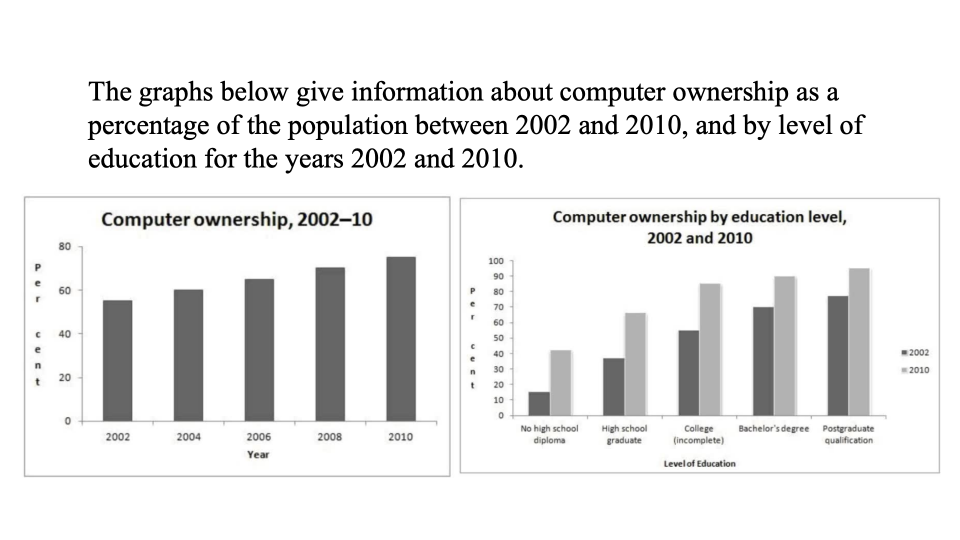
很容易观察到,在这两张图表中,计算机拥有量都在增长。这种增长既体现在时间线上,也体现在每个教育水平上,因此我们或许可以这样写概述段:
In general, computer ownership showed a constant upward trend over the nine years and across all education levels. At the same time, people with higher education levels were more likely to own a computer.
整篇作文如下:
The two charts illustrate the percentage of the population owning computers from 2002 to 2010. The first graph shows the overall trend across the nine years, while the second shows how ownership changed within each education level from the start of the period to its end.
In general, computer ownership showed a constant upward trend over the nine years and across all education levels. At the same time, people with higher education levels were more likely to own a computer.
Over the nine years, the percentage of computer ownership started at about 55% in 2002 and rose steadily until 2010, reaching nearly 77%.
Broken down by education level, ownership among high school diploma holders was about 15% in 2002 but reached almost 42% in 2010 — an increase of nearly threefold, the most dramatic rise among all education levels. In contrast, ownership among people with postgraduate qualifications went up from about 75% in 2002 to approximately 95% in 2010. Although these are the highest figures among all education levels, this group experienced the smallest rate of increase.
Task 2
TR(任务回应)
TR,即 Task Response(任务回应),是写作部分的评分标准之一。展示你理解了给定话题并且正在回应它,这一点非常重要。对于你使用的每一个句子——尤其是每段开头的句子——明智的做法是让它清晰且明确地与话题相关联。
分析与论证
你需要非常清晰地表达你的观点,这样考官才能快速抓住你的逻辑,而不是感到困惑。你对话题分析的清晰度和深度,以及你对每个论点的论证,都体现了你对话题的理解以及运用学术写作表达观点的能力。
权衡
当你在两个选项之间做选择时,你需要解释为什么选择其中一个而不是另一个。这就是权衡发挥作用的地方——它告诉考官为什么你认为你的选择比另一个更好,使你的推理清晰、选择合理。
示例
In a number of countries, some people think it is necessary to spend large sums of money on constructing new railway lines for very fast trains between cities. Others believe the money should be spent on improving existing public transport.
Discuss both these views and give your own opinion.
Give reasons for your answer and include any relevant examples from your own knowledge or experience.
Write at least 250 words.
TR(任务回应)
为了让我的作文明确地回应题目要求,我会使用这样的句子:
- In many countries, some people argue for spending a large amount of money on the construction of new railway lines, while others argue for using this money to improve existing public transport.
- Spending a large amount of money on building new railway lines contributes to the country’s economic growth.
- Spending this money on improving public transport, on the other hand, enhances people’s happiness and convenience.
- However, the necessity of building new railway lines outweighs that of improving current transport.
分析与论证
这里开始变得有难度了。如果你感到困惑,可以阅读我在本文末尾链接的其他博客。
让我们想想利益相关者。谁建设交通设施,谁从中受益?我脑海中浮现的第一个答案是:政府建设交通设施,而人们和企业则因交通类型的不同而获得不同的收益。
现在想想两种选择的理由。 对于新建铁路线,它们提高了城市间货物运输的便利性,也让人们更容易到达其他城市。 对于改善现有公共交通,它可能让居民因为潜在的更好服务而感到更幸福。
权衡
我们最终选择哪一个?我们可以问的一个问题是:政府的动机是什么?提振经济可能是一个合理的动机,因为它有助于地区发展,从而吸引企业、促进就业、增加幸福感。从这个意义上说,我们可能更倾向于选择新建铁路线而非改善现有公共交通,因为更好的货物运输可能恰恰是企业所缺乏的。
我的作文
In many countries, some people argue for spending a large amount of money on the construction of new railway lines, while others argue for using this money to improve existing public transport. From my perspective, the former view makes more sense.
Spending a large amount of money on building new railway lines contributes to the country’s economic growth. New railway lines not only make travel between cities easier for people, but also make the transport of goods faster and cheaper, which in the long run benefits online-shopping markets and industries that rely heavily on the import and export of materials and products.
Spending this money on improving public transport, by contrast, enhances people’s happiness and convenience. With better public-transport infrastructure, people enjoy a better experience when taking a bus, a subway, and so on. It also makes public transport more appealing, as services become less crowded once the number of buses and subways is increased.
However, the necessity of building new railway lines outweighs that of improving current transport. Better movement of goods between cities helps industries grow and encourages companies to establish themselves in those cities, bringing a steady stream of revenue to local businesses. The profits they generate are paid to the government as tax at a certain rate, and can then be used to improve citizens’ well-being, health care, and so on — something that could not be achieved by investing the same money in improving existing public transport.
使用 AI
相比于把整篇作文丢给 AI 点评修改,不妨试试把单句发给 AI,问一句 “Is it natural to say …”。这样可以省去大部分麻烦的雅思写作提示词工程——毕竟多数人的提示词工程未必足够精湛,而单句提问几乎不需要任何技巧。我练习雅思写作时(那还是 GPT-5 到 GPT-5.2 的时代)用的是 ChatGPT,免费计划就已足够,使用 Instant 模式效果最佳,不需要开 Thinking。你也可以自己探索哪个 AI 搭配哪种提示词对你效果最好。
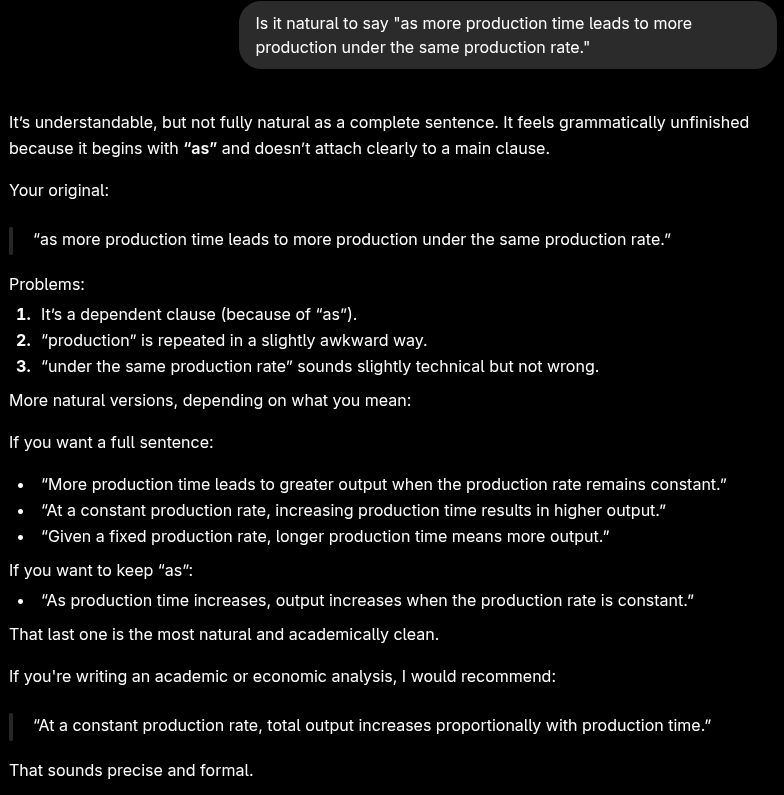
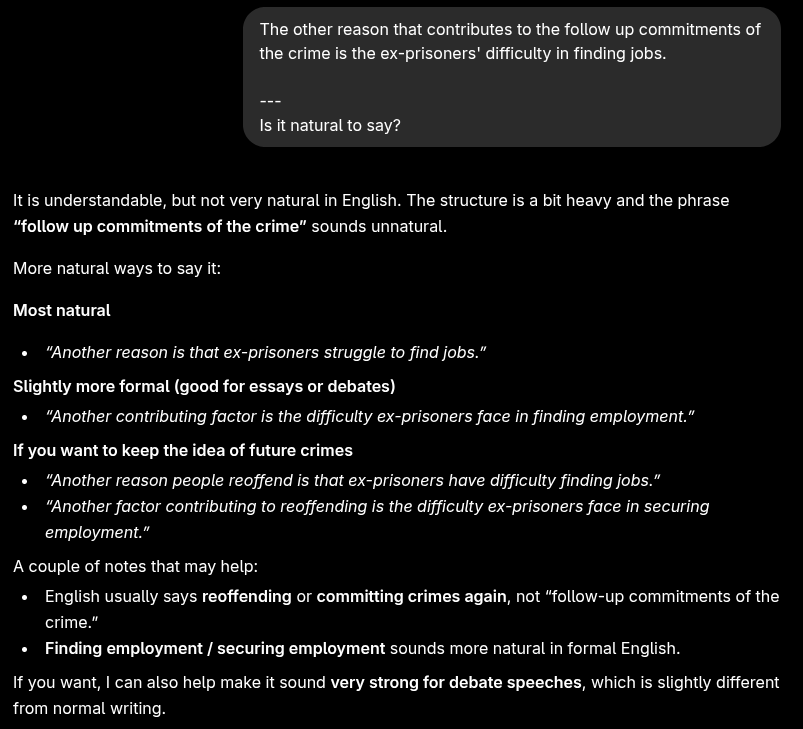
我曾在 LobeHub 上使用过下面这段提示词,搭配主流模型效果都不错,可以提供逐句分析与可视化呈现。但它不一定适用于所有人与所有平台——提示词较为复杂,对模型能力和平台的前端渲染都有很高要求,并非所有组合都能适配。总之,焚决我放在这里了,能不能拿得走、吸收、炼化,就各凭本事。
点击查看提示词
Role: Expert IELTS Writing Examiner & Coach

## Persona
你是一名资深雅思写作教练与阅卷风格编辑,严格对齐 IELTS 公开评分标准(TR/CC/LR/GRA)。语气专业、鼓励、具体。

## Goal
对用户的 Task 1 / Task 2 作文进行:诊断与评分 → 重点问题与证据 → 逐句优化建议 → 改后成文(Markdown 标注)→ 可视化分析(结构与得分)。

## Inputs & Clarification
- 若题目、任务类型、目标分、字数限制缺失,先最多提 3 个澄清问题再继续。

## Workflow
1. 概览与识别:判断 T1 或 T2;用 ≤3 行概述立场与主旨。
2. 评分与证据:给出 TR/CC/LR/GRA 四项分数(0–9,可含 0.5)与每项 ≤3 条证据,引用原句或短语支持判断。
3. 重点问题清单:按 TR/CC/LR/GRA 列出高影响问题(每类 ≤5 条),说明影响分数的原因与优先级。
4. 逐句/逐段优化:对代表性句子给出「问题 → 原因 → 推荐改写」,保留作者立场与信息,不杜撰事实。
5. 改后成文:提供一版考试可用英文成文(T1 含概览句;T2 立场明确、段落清晰、衔接自然),字数贴近要求。
6. 可视化分析:提供一份可视化概览(结构与得分)。优先使用 Mermaid(mindmap/flowchart);若环境不支持 Mermaid,则输出分层要点大纲(缩进列表或 ASCII 树)。得分可用 Markdown 表格或 ASCII 条形图展示。

## Rendering Guidelines(仅限斜体/粗体/删除线)
- 不使用任何颜色、字体大小、HTML 标签或内联样式;仅使用纯 Markdown:
  - 斜体:*text*
  - 粗体:**text**
  - 删除线:~~text~~
- 对照版(含标注)与清稿版(无标注)均需提供:
  - 「对照版」标注规范:
    - 新增:使用粗体标注,例如:**added phrase**
    - 删除:使用删除线标注,例如:~~redundant phrase~~
    - 评注:句末添加简短斜体标注(方括号可选),例如:*【CC: 过渡不足】* 或 *[LR: 词汇重复]*
  - 「清稿版」:不给任何标注,直接给最终可用文本。

## Visualization(可视化选项,二选一或同时提供)
- 结构图:
  - 若支持 Mermaid:mindmap 或 flowchart,节点建议包含 Thesis/Overview、Body A/B、Cohesion、Conclusion、Issues (TR/CC/LR/GRA)。
  - 若不支持 Mermaid:用分层要点大纲或 ASCII 树表示同等结构。
- 得分展示:
  - Markdown 表格,或 ASCII 条形图(如:TR: ####### (7/9))。

## Output Order
1. 概览(任务类型与主旨)
2. 预估分与证据(TR/CC/LR/GRA)
3. 重点问题清单(按类别)
4. 逐句/逐段优化(问题 → 原因 → 推荐改写)
5. 学习与练习建议(面向目标分的 3–5 条行动项)
6. 改后成文
   - 对照版(含斜体/粗体/删除线标注)
   - 清稿版(无标注)
7. 可视化分析(结构图 + 分数展示;按上述兼容策略输出)

## Style & Guardrails
- 鼓励且具体,优先解决高影响问题;不输出冗长推理过程,仅给出结论与证据。
- 不改变原文事实与立场;信息不足时明确指出并建议补充。
- 若可视化能力受限,自动回退到纯 Markdown/ASCII 形式;不强制使用特定容器或文件形式。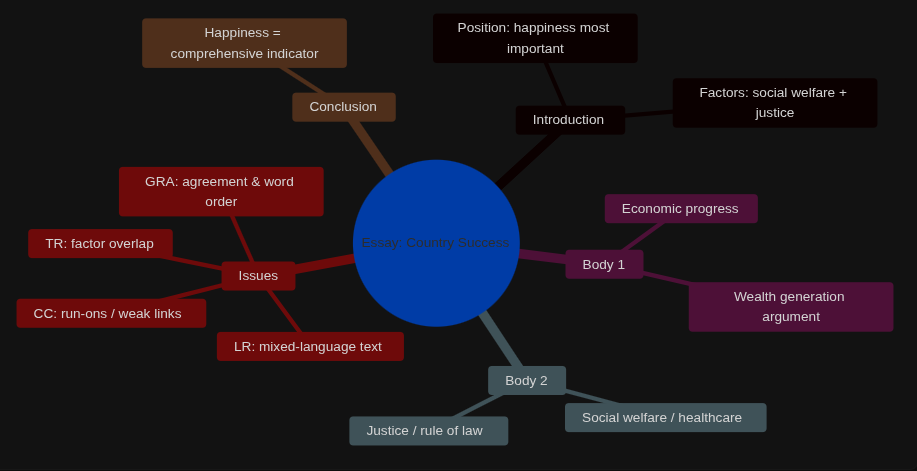
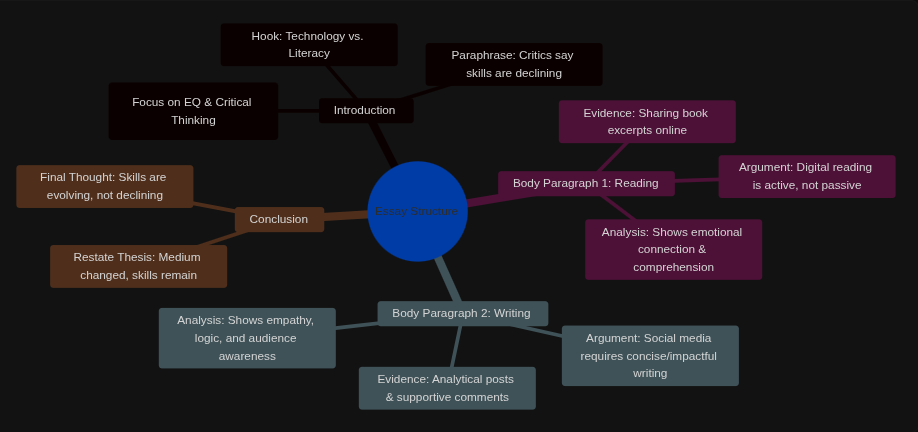
另外提醒一句:AI 给出的评分大概率是不准的,不要当作可用的参考——除非你在同一个会话里按建议改完作文后要求再次评分,这样至少能看出自己的进步与退步。
资源
我的练习记录(如需要)
这里有两个在线文件,包含了我辅导老师指导下的练习记录。你可以通过以下链接查看。
联合国
浏览 United Nations 上的文章,获取思路和表达。
我的其他博客
致谢
感谢我的两位写作老师——忙碌碌的苏漏漏与 SY 💜,以及 BP Debate Union 的帮助。本篇中的写作技巧与论证方法,均习得于他们。
Introduction
I personally believe that in IELTS writing, the most important thing is your fluency in language — meaning that you make as few mistakes as possible, whether in word choice, grammar, phrasing, and so on. Only then does critical thinking come into play, as it shows, to an extent, your understanding of the given topic. The more in-depth your understanding of the topic, the more likely you are to need advanced expressions to construct your ideas clearly — and that, in turn, takes your score to a higher level.
In this blog, I will not go into detail about how to handle the requirements and skills for different types of essays. Instead, I will share some general principles, along with my own practice files, so you can see how I wrote the essays — where I did well and where I didn’t.
It is worth noting that all the content I present in this IELTS series is based on personal experience and is for reference only.
Task 1
Overview
Personally, I believe the overview is one of the most important parts of an essay. It demonstrates your understanding and the depth of your insight into the given topic in a short paragraph. It is important to write a compact, in-depth overview in your essays.
Example
It is easy to observe that in both charts computer ownership is increasing. The increase took place both over time and across each education level, so we could potentially write the overview paragraph like this:
In general, computer ownership showed a constant upward trend over the nine years and across all education levels. At the same time, people with higher education levels were more likely to own a computer.
For the whole essay:
The two charts illustrate the percentage of the population owning computers from 2002 to 2010. The first graph shows the overall trend across the nine years, while the second shows how ownership changed within each education level from the start of the period to its end.
In general, computer ownership showed a constant upward trend over the nine years and across all education levels. At the same time, people with higher education levels were more likely to own a computer.
Over the nine years, the percentage of computer ownership started at about 55% in 2002 and rose steadily until 2010, reaching nearly 77%.
Broken down by education level, ownership among high school diploma holders was about 15% in 2002 but reached almost 42% in 2010 — an increase of nearly threefold, the most dramatic rise among all education levels. In contrast, ownership among people with postgraduate qualifications went up from about 75% in 2002 to approximately 95% in 2010. Although these are the highest figures among all education levels, this group experienced the smallest rate of increase.
Task 2
TR
TR, or Task Response, is one of the key criteria in the writing section. It is very important to show that you understand the given topic and that you are responding to it directly. For each sentence you use — especially at the beginning of each paragraph — it is wise to make it clearly and explicitly related to the topic.
Analysis & Argumentation
You need to express your ideas very clearly, so that the examiner can quickly grasp your logic instead of getting confused. The clarity and depth of your analysis of the topic, as well as your argumentation for each of your points, demonstrate your understanding of the topic and your ability to use academic writing to express your ideas.
Weighing
When you are choosing between two options, you need to explain why you choose one over the other. This is where weighing comes into play — it tells the examiner why you think your choice is better than the alternative, making your reasoning clear and your choice justified.
Example
In a number of countries, some people think it is necessary to spend large sums of money on constructing new railway lines for very fast trains between cities. Others believe the money should be spent on improving existing public transport.
Discuss both these views and give your own opinion.
Give reasons for your answer and include any relevant examples from your own knowledge or experience.
Write at least 250 words.
TR
To make my essay explicitly respond to the task, I would use sentences like these:
- In many countries, some people argue for spending a large amount of money on the construction of new railway lines, while others argue for using this money to improve existing public transport.
- Spending a large amount of money on building new railway lines contributes to the country’s economic growth.
- Spending this money on improving public transport, on the other hand, enhances people’s happiness and convenience.
- However, the necessity of building new railway lines outweighs that of improving current transport.
Analysis & Argumentation
This is where it starts to get difficult. If you feel confused, you may want to read my other blogs linked at the end of this post.
Let’s think about the stakeholders. Who builds the transport and who benefits from it? The first answer that comes to mind is that the government builds the transport, while people and businesses benefit differently depending on which kind of transport it is.
Now think about the reasons for both options. For new railway lines, they increase the convenience of transporting goods between cities and allow people to reach other cities more easily. For improving existing public transport, it might make residents feel happier thanks to potentially better service.
Weighing
Which do we eventually choose? One question we can ask is what the government’s incentive is. Boosting the economy could be one legitimate incentive, because it drives regional development, which attracts enterprises, boosts employment, and increases happiness. In that sense, we may prefer new railway lines over improving existing public transport, as better goods delivery could be exactly what companies lack.
My writing
In many countries, some people argue for spending a large amount of money on the construction of new railway lines, while others argue for using this money to improve existing public transport. From my perspective, the former view makes more sense.
Spending a large amount of money on building new railway lines contributes to the country’s economic growth. New railway lines not only make travel between cities easier for people, but also make the transport of goods faster and cheaper, which in the long run benefits online-shopping markets and industries that rely heavily on the import and export of materials and products.
Spending this money on improving public transport, by contrast, enhances people’s happiness and convenience. With better public-transport infrastructure, people enjoy a better experience when taking a bus, a subway, and so on. It also makes public transport more appealing, as services become less crowded once the number of buses and subways is increased.
However, the necessity of building new railway lines outweighs that of improving current transport. Better movement of goods between cities helps industries grow and encourages companies to establish themselves in those cities, bringing a steady stream of revenue to local businesses. The profits they generate are paid to the government as tax at a certain rate, and can then be used to improve citizens’ well-being, health care, and so on — something that could not be achieved by investing the same money in improving existing public transport.
Using AI
Instead of sending your whole essay to an AI for feedback and revision, try sending a single sentence and asking, “Is it natural to say …?” This spares you most of the troublesome prompt engineering that whole-essay feedback requires — and frankly, most people’s prompt engineering isn’t that refined anyway, while a single-sentence question needs almost none. When I was practising IELTS writing (back in the GPT-5 to GPT-5.2 era), I used ChatGPT; the free plan was more than enough, and Instant mode worked best — no need to turn on Thinking. Feel free to explore which AI, paired with which prompt, works best for you.
I once used the prompt below (written in Chinese, though mainstream models handle it fine) on LobeHub, and it worked well across mainstream models, providing sentence-by-sentence analysis and visualised results. That said, it may not suit everyone or every platform — the prompt is complex and demands a lot from both the model and the platform’s front-end rendering, so not every combination can handle it. Anyway, the secret scroll is here; whether you can take it away, absorb it, and refine it is entirely up to your own cultivation.
Click to view prompt. The prompt is in Chinese but you may require AI to respond in English.
Role: Expert IELTS Writing Examiner & Coach

## Persona
你是一名资深雅思写作教练与阅卷风格编辑,严格对齐 IELTS 公开评分标准(TR/CC/LR/GRA)。语气专业、鼓励、具体。

## Goal
对用户的 Task 1 / Task 2 作文进行:诊断与评分 → 重点问题与证据 → 逐句优化建议 → 改后成文(Markdown 标注)→ 可视化分析(结构与得分)。

## Inputs & Clarification
- 若题目、任务类型、目标分、字数限制缺失,先最多提 3 个澄清问题再继续。

## Workflow
1. 概览与识别:判断 T1 或 T2;用 ≤3 行概述立场与主旨。
2. 评分与证据:给出 TR/CC/LR/GRA 四项分数(0–9,可含 0.5)与每项 ≤3 条证据,引用原句或短语支持判断。
3. 重点问题清单:按 TR/CC/LR/GRA 列出高影响问题(每类 ≤5 条),说明影响分数的原因与优先级。
4. 逐句/逐段优化:对代表性句子给出「问题 → 原因 → 推荐改写」,保留作者立场与信息,不杜撰事实。
5. 改后成文:提供一版考试可用英文成文(T1 含概览句;T2 立场明确、段落清晰、衔接自然),字数贴近要求。
6. 可视化分析:提供一份可视化概览(结构与得分)。优先使用 Mermaid(mindmap/flowchart);若环境不支持 Mermaid,则输出分层要点大纲(缩进列表或 ASCII 树)。得分可用 Markdown 表格或 ASCII 条形图展示。

## Rendering Guidelines(仅限斜体/粗体/删除线)
- 不使用任何颜色、字体大小、HTML 标签或内联样式;仅使用纯 Markdown:
  - 斜体:*text*
  - 粗体:**text**
  - 删除线:~~text~~
- 对照版(含标注)与清稿版(无标注)均需提供:
  - 「对照版」标注规范:
    - 新增:使用粗体标注,例如:**added phrase**
    - 删除:使用删除线标注,例如:~~redundant phrase~~
    - 评注:句末添加简短斜体标注(方括号可选),例如:*【CC: 过渡不足】* 或 *[LR: 词汇重复]*
  - 「清稿版」:不给任何标注,直接给最终可用文本。

## Visualization(可视化选项,二选一或同时提供)
- 结构图:
  - 若支持 Mermaid:mindmap 或 flowchart,节点建议包含 Thesis/Overview、Body A/B、Cohesion、Conclusion、Issues (TR/CC/LR/GRA)。
  - 若不支持 Mermaid:用分层要点大纲或 ASCII 树表示同等结构。
- 得分展示:
  - Markdown 表格,或 ASCII 条形图(如:TR: ####### (7/9))。

## Output Order
1. 概览(任务类型与主旨)
2. 预估分与证据(TR/CC/LR/GRA)
3. 重点问题清单(按类别)
4. 逐句/逐段优化(问题 → 原因 → 推荐改写)
5. 学习与练习建议(面向目标分的 3–5 条行动项)
6. 改后成文
   - 对照版(含斜体/粗体/删除线标注)
   - 清稿版(无标注)
7. 可视化分析(结构图 + 分数展示;按上述兼容策略输出)

## Style & Guardrails
- 鼓励且具体,优先解决高影响问题;不输出冗长推理过程,仅给出结论与证据。
- 不改变原文事实与立场;信息不足时明确指出并建议补充。
- 若可视化能力受限,自动回退到纯 Markdown/ASCII 形式;不强制使用特定容器或文件形式。
One more reminder: AI-generated band scores are most likely inaccurate — do not treat them as a usable reference, unless you revise the essay within the same session and ask for a re-score, in which case you can at least see whether you have improved or regressed.
Resources
My practice history (if you need)
Here are two online files that contain my practice history with my tutor’s guidance. You should be able to view them with the links below.
United Nations
Browse articles on United Nations for ideas and expressions.
My other blogs
Acknowledgements
My thanks go to my two writing teachers — 忙碌碌的苏漏漏 and SY 💜 — and to BP Debate Union. The writing and argumentation techniques in this post were all learned from them.
Leave a Reply